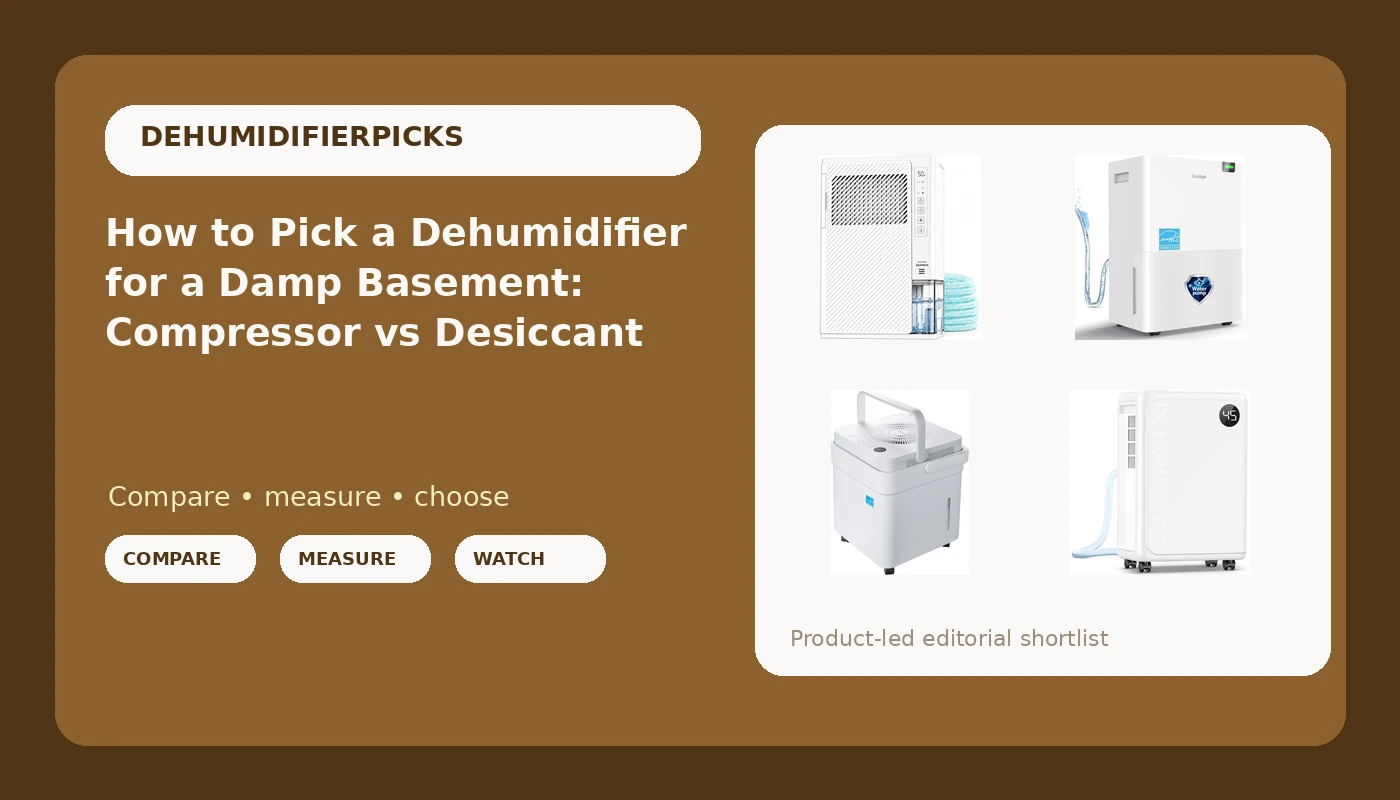
A dehumidifier for a damp basement is a different purchase than a dehumidifier for a bedroom, and most of the confusion comes from two numbers quoted out of context: pints per day and square footage. Pints per day is measured at one fixed laboratory temperature and humidity. Square footage is a rough ceiling, not a promise. Neither number tells you whether the machine will still be doing anything useful at 3 a.m. in July, or whether you will be carrying a sloshing tank up a staircase every morning.
The four units below cover the realistic range for a house: two compressor machines in the 32 to 35 pint class, one high-capacity Energy Star unit with a replaceable pump, and one desiccant unit built for cold rooms. What follows is how to read the specs, where the temperature split changes the answer, and which one to buy for your space.
Related: Dehumidifier Sizing: How Many Pints You Actually Need →
Quick answer
Match the unit to the temperature of the space and the drain you can reach before you compare pint ratings. For a basement that stays above roughly 65 degrees Fahrenheit, a compressor unit in the 32 to 35 pint class handles a normal single-family basement once it is on a hose drain. For a cold basement, a garage, or a room that drops into the 50s, a desiccant unit keeps working when a compressor coil would frost and cycle off. If the machine will run unattended for weeks, prioritize a hose drain, auto restart after a power outage, and a built-in pump if the drain is uphill or far from the unit.
Four useful options
| Model | Best fit | What stands out |
|---|---|---|
| Gasbye Energy Star 2026 Dehumidifier with [𝗥𝗲𝗽𝗹𝗮𝗰𝗲𝗮𝗯𝗹𝗲 Pump] for Basement, [44dB Quiet, Easy to Clean & Clog-Free], Max 75 Pints/Day, 16.5ft Drain Hose, Auto Shut-Off, Auto Restart, White | Whole-basement duty that runs unattended | Replaceable pump, 16.5 ft hose, auto shut-off and auto restart, stated 75 pint per day maximum |
| Midea Cube 35 Pint Dehumidifier for Basement, 3,500 Sq. Ft, Energy star | Large open basement that stays warm | 35 pint Energy Star compressor, stated coverage up to 3,500 sq ft |
| AEOCKY 2000 Sq.Ft Rotary Desiccant Dehumidifier, Humidistat, Never Frost | Cold rooms and shoulder-season basements | Rotary desiccant rotor, humidistat, never-frost operation, stated coverage up to 2,000 sq ft |
| 32 Pint Dehumidifier for Basement and Home, 2500 Sq Ft with Drain Hose | One damp room or a small finished basement | 32 pint compressor with a drain hose in the box, stated coverage up to 2,500 sq ft |
The whole-basement pick: Gasbye Energy Star 2026 Dehumidifier with [𝗥𝗲𝗽𝗹𝗮𝗰𝗲𝗮𝗯𝗹𝗲 Pump] for Basement, [44dB Quiet, Easy to Clean & Clog-Free], Max 75 Pints/Day, 16.5ft Drain Hose, Auto Shut-Off, Auto Restart, White
The pump is the reason this one sits at the top of the group for a finished basement. Gravity drains only work when the outlet is lower than the unit, which rules out most basement layouts where the only drain is a slop sink across the room or a laundry connection above floor level. A pump also solves the vacation problem: with a hose in place and auto restart enabled, a mid-summer storm that knocks the power out does not leave you with a full tank and a stopped machine. Treat the stated 75 pints per day as a ceiling measured under favorable conditions, and treat the pump as a wear item, which is exactly why a replaceable one matters more than a sealed one.
The big-room compressor: Midea Cube 35 Pint Dehumidifier for Basement, 3,500 Sq. Ft, Energy star
Compressor units are the right default for most basements in warm climates because they pull more water per watt than a desiccant rotor when the air is already warm. The trade-off is temperature. As a basement cools toward the mid 60s and below, the evaporator coil gets cold enough to frost, and the machine spends part of its cycle in a defrost pause instead of removing water. That is not a defect, it is physics, and it is why the same 35 pints of rated capacity behaves differently in August than in February. Put this unit on a hose drain and set the humidistat where you want it, because a tank that fills on day three is a machine that stops working on day three.
The cold-basement pick: AEOCKY 2000 Sq.Ft Rotary Desiccant Dehumidifier, Humidistat, Never Frost
The never-frost wording is the whole pitch here, and it is worth understanding rather than dismissing. A desiccant rotor has no evaporator coil to ice over, so there is no defrost cycle eating into runtime and no drop in output as the space cools. The cost shows up on the electric bill: a desiccant machine generally draws more power per pint of water removed than a compressor does in warm air. If your basement stays above 65 degrees all year, this is the wrong tool and you will pay for it monthly. If your basement is cold for half the year, it is the only one of these four that keeps working through that half.
The budget hose-drain pick: 32 Pint Dehumidifier for Basement and Home, 2500 Sq Ft with Drain Hose
Smaller compressors are not weaker machines, they are smaller ones, and the difference matters most when you point them at a space that is too big. A 32 pint unit in a closed 400 sq ft bedroom will hold 50 percent relative humidity comfortably. The same unit trying to dry a 2,000 sq ft open basement with a leaky bulkhead door will run continuously and never quite catch up. The stated 2,500 sq ft coverage is a maximum under favorable conditions, so use it as the ceiling and not the target. If the space is bigger than the number suggests, two smaller units placed apart usually beat one large unit in a corner.
Prices and availability may change. Product images, names, and retailer links are matched to verified listings. No current price, rating, stock status, or measured result is stated here without current evidence.
Pints per day is a lab number
Every pint rating on a box is measured at one fixed set of conditions, typically a warm room at a controlled humidity. Your basement is not that room. It has door gaps, a stairwell open to the rest of the house, a concrete floor that releases moisture slowly, and a temperature that drops at night. In real conditions, the honest working number is roughly 30 to 40 percent below the printed rating, and that gap widens in cold weather for any compressor unit.
So how do you size without a laboratory? Start with what the space feels like and what you can see. A musty smell and a sticky floor in one room is a small load. Damp drywall, condensation on pipes, or a persistent smell that reaches the stairs is a larger one. A hygrometer placed in the far corner, read in the morning and again in the evening, tells you more than square footage ever will, because it measures the humidity the machine actually has to fight rather than the area it sits in.
Compressor or desiccant
A compressor dehumidifier works like a refrigerator: a fan pulls air across a cold coil, water condenses, and the water drips into a tank or a hose. It is efficient in warm air and it is what most basements need. Its weakness is cold. Below roughly 65 degrees, the coil can frost, the machine pauses to defrost, and output falls.
A desiccant dehumidifier works differently. Air passes through a rotor coated with a material that attracts moisture, and a heater dries that rotor so it can keep absorbing. There is no cold coil, so there is no frost and no defrost pause, which is why a desiccant unit keeps removing water in a 50 degree basement. The trade is power draw per pint, which is generally higher than a compressor in warm conditions.
If your space is warm year round, buy a compressor. If it is cold for months at a time, buy a desiccant. If it is both, that is the case where two machines genuinely make more sense than one.
- Measure the temperature, not just the square footage. A hygrometer reading in the far corner at two different times of day tells you the real load.
- Decide where the water goes before you buy. Gravity hose, pumped hose, or tank. A basement usually means hose, and an uphill run means pump.
- Choose the technology by temperature. Compressor above roughly 65 degrees, desiccant below.
- Size to the load, not the coverage claim. A 32 to 35 pint machine covers a normal basement room or a small finished space; larger or wetter spaces need more capacity or a second unit.
- Check the failure behavior. Auto restart after a power outage, auto shut-off when the tank is full, and a humidistat you can set and forget.
Practical guidance for a basement install
- Run the hose drain before you run the machine. A unit on a tank is a unit that stops when the tank fills, and that is usually overnight.
- Set the humidistat around 50 percent and leave it. Lower settings do not dry the room faster, they just keep the compressor running longer.
- Leave clearance around the unit. A few inches off the wall and away from curtains keeps airflow up and prevents the machine from measuring its own exhaust.
- Wash the filter on a schedule. A clogged filter quietly costs you capacity, and it is the most common reason a working unit starts underperforming.
- Seal the obvious air leaks. A dehumidifier fighting an open bulkhead door or an unsealed rim joist will run forever and still lose.
Which option should you choose?
Choose the Gasbye Energy Star 2026 Dehumidifier with [𝗥𝗲𝗽𝗹𝗮𝗰𝗲𝗮𝗯𝗹𝗲 Pump] for Basement, [44dB Quiet, Easy to Clean & Clog-Free], Max 75 Pints/Day, 16.5ft Drain Hose, Auto Shut-Off, Auto Restart, White when the basement will run unattended and the only drain is uphill or across the room. Choose the Midea Cube 35 Pint Dehumidifier for Basement, 3,500 Sq. Ft, Energy star when the space is large, open, and stays warm, and a compressor is at its most efficient. Choose the AEOCKY 2000 Sq.Ft Rotary Desiccant Dehumidifier, Humidistat, Never Frost when the basement, garage, or crawlspace is cold enough that a compressor coil would frost. Choose the 32 Pint Dehumidifier for Basement and Home, 2500 Sq Ft with Drain Hose when one damp room or a small finished basement is the whole problem.
The caveat is the one that decides most of these purchases: coverage numbers and pint ratings are ceilings under favorable conditions, not guarantees in your house. If your measured humidity stays high after a correctly sized unit has been running for a week, the answer is usually more capacity or a second unit, not a different brand.
The bottom line
The right dehumidifier for a damp basement is the one that matches three things: the temperature of the space, the drain you can reach, and how long it will run without you. Warm basement and a gravity drain points to a compressor unit in the 32 to 35 pint class. Cold basement points to a desiccant. A long unattended run with no floor drain points to a pump. Get those three right and the pint rating on the box becomes a detail rather than the decision.