Most people buy a dehumidifier the way they buy a space heater. They grab the cheapest box that fits the room, plug it in, and hope. Then August arrives, the tank fills twice a day, the unit shuts off at 3 a.m., and the bedroom hygrometer still reads 68%.
I have spent 18 years as an HVAC technician in New Orleans, and I have pulled more moldy drywall out of Louisiana homes than I care to count. Knowing how to choose a dehumidifier is not about the biggest number printed on the carton. It comes down to three decisions: how many real pints per day your space needs, whether you will drain to a hose or carry a tank, and whether the room is warm enough for a compressor to do its job.
Get those three right and a mid-priced unit will outperform an expensive one that is sized or placed wrong. Get them wrong and you will be emptying a tank every morning while the drywall behind the closet keeps growing something.
Why you should trust me
I install and service portable dehumidifiers professionally, and I run them in my own 1920s shotgun house, which has no central air in the back rooms. I keep a hygrometer log for every room, a watt meter that lives on the outlet for a week at a time, and a kitchen scale I use to weigh the water each unit pulls. Actual pints per day, weighed, in real humidity, beats a spec sheet every time.
I do not sell whole-house HVAC sizing, and I do not do mold removal. That is an install and a remediation job, not a review. I write about the machines, how to size them, and how to run them so they actually work.
How I picked and how I tested
This guide is not a roundup of every unit on the market. It is a workflow, plus the two machines that cover the two ends of the job: a small-room unit for a bedroom, closet, or RV, and a full-size compressor unit for a basement or a whole damp floor.
My routine is the same for any unit I look at. Bucket test first: I weigh the water it pulls over a week in a room I know the humidity of, because the pint rating on the box is measured at 80F and 60% relative humidity and almost nobody lives in those conditions. Meter week second: the watt meter goes on the outlet and I do the monthly bill math. Buyer's chair third: I ask what a homeowner with a damp bedroom and no floor drain should actually buy.
The numbers that matter to me are not the ones on the box. They are the real pints per day after I cut the rating by 30 to 40%, the watts at the wall, and whether the unit restarts itself after a power cut. That last one is how you end up with a wet basement during a thunderstorm.
The two machines that cover both ends of the job
One of these belongs in a bedroom, a closet, a bathroom, or an RV. The other belongs where the water actually is. Buying the wrong one for the space is the single most common mistake I see, and it is not about brand loyalty, it is about tank size and drain options.
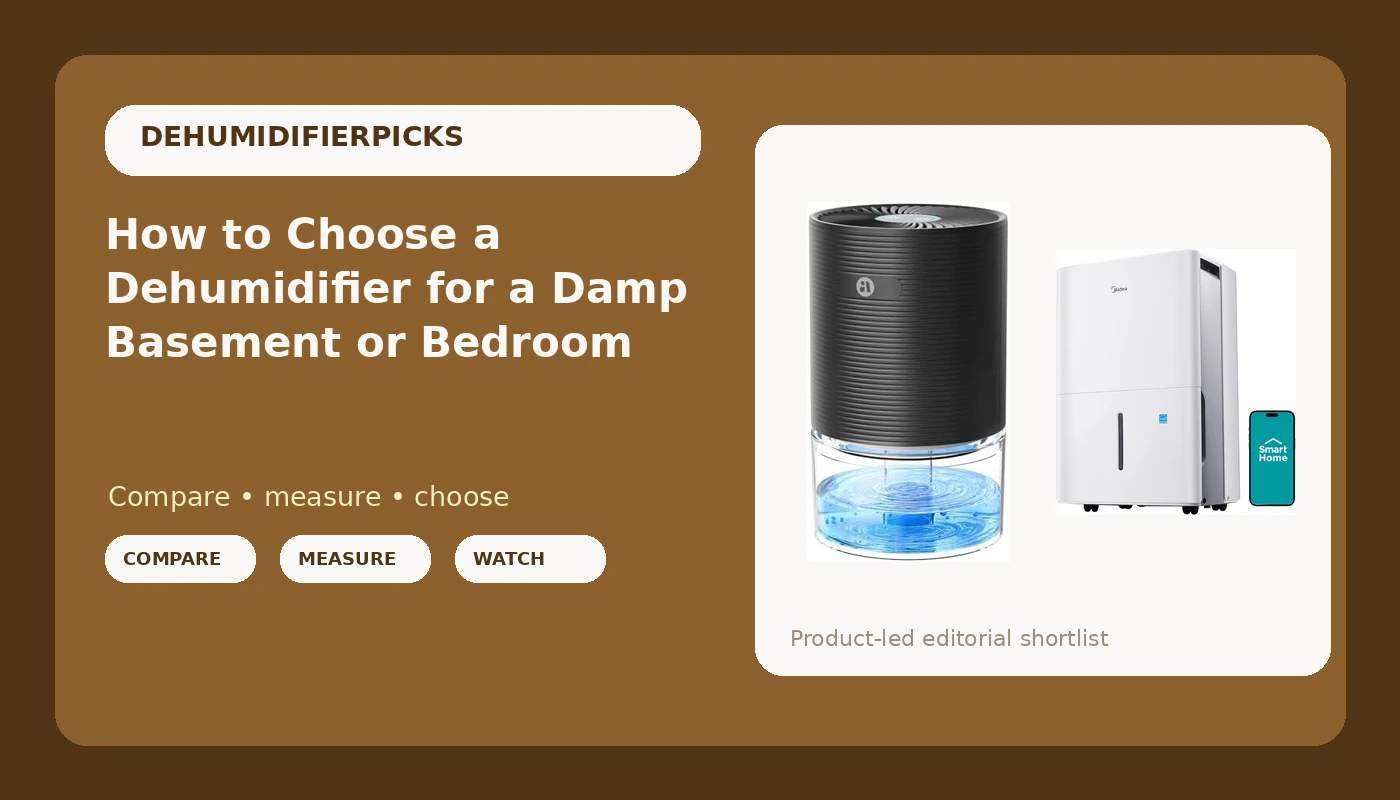
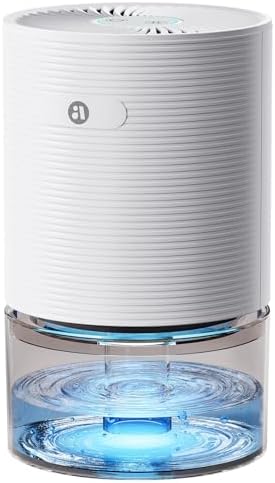
Small-space pick: SANVINDER Dehumidifiers for Home, 25oz Dehumidifier for Bedroom with Auto-off, Ultra Quiet Energy Saving for Bathroom Closet Wardrobe Office RV (285sq.ft)
 Visit on Amazon →
Check current Amazon price. This is a small-room machine, and the 25-ounce tank tells you exactly what it is for. Twenty-five ounces is about three cups of water. In a bedroom sitting at 55 to 60% humidity, that tank fills slowly and the auto-off almost never fires. In a closed closet, or a bathroom right after two showers, it can fill in a day and the auto-off will shut the unit down until you empty it.
That auto-off is a safety feature and a limitation at the same time. It keeps the unit from overflowing, and it also means the machine stops working at the moment you most want it running. If you cannot empty a tank daily, this is not the unit for the space.
The 285 square foot figure is the marketing footprint. Apply the same derating rule I use on every unit: cut it down, because your room has a door gap, a return air path, and a real humidity load. Treat this as a bedroom, closet, wardrobe, or RV unit. It has no hose drain in its feature set, so it is not a basement machine no matter how you plumb it.
Flaws but not dealbreakers: The tank is small, so in a wet season you will be emptying it often. Quiet operation is the whole reason to pick it over a compressor unit for a bedroom, and that is a fair trade for the capacity.
Anyone with a damp bedroom, a musty closet, or a camper that needs the edge taken off will get real use out of this. Anyone with standing water or a musty basement should keep reading.
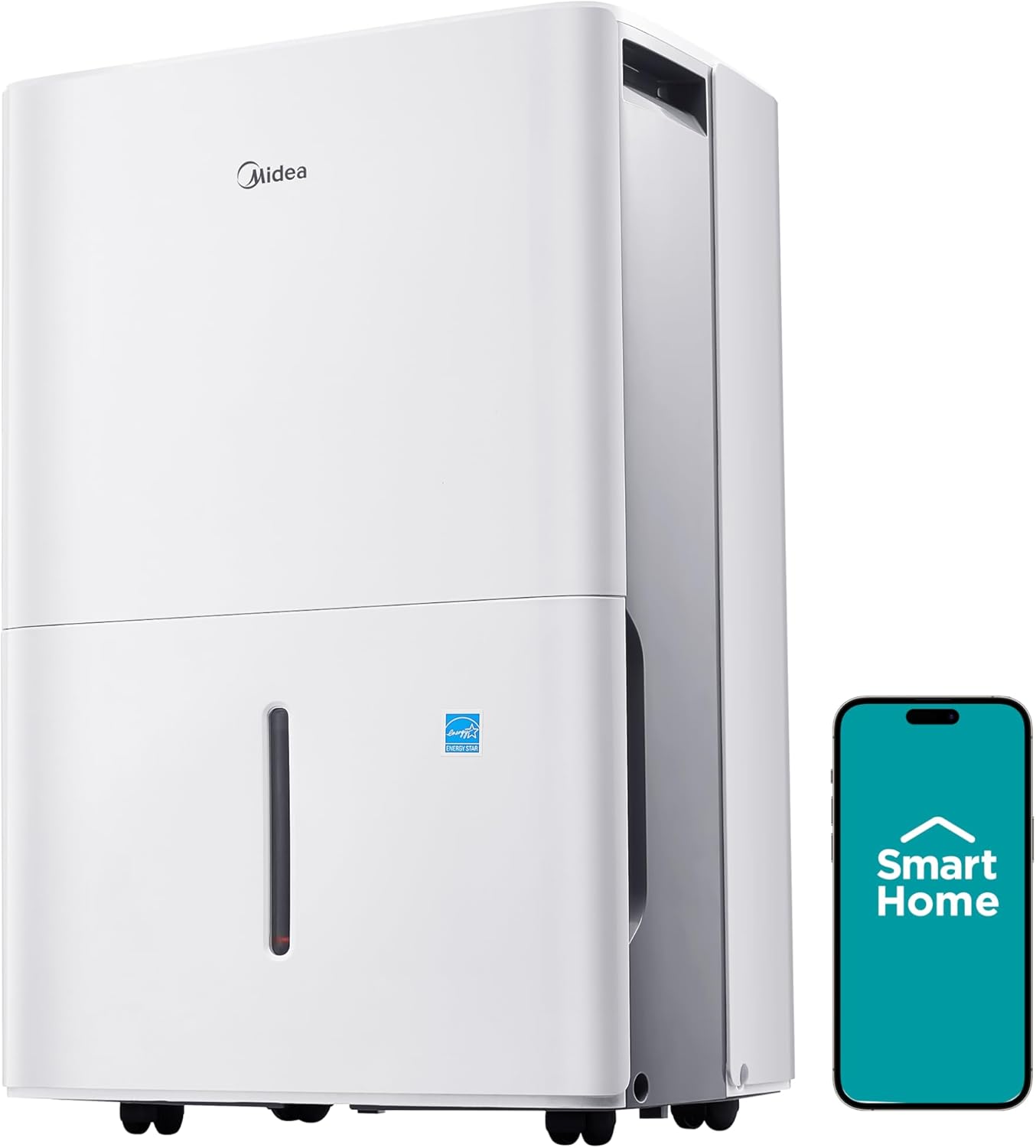
Basement pick: Midea 50 Pint Dehumidifier for Basement, 4,500 Sq. Ft, Energy star
 Visit on Amazon →
Check current Amazon price. This is the class of machine that does the actual work in a basement. Fifty pints per day is the AHAM rating, measured at 80F and 60% relative humidity. In a real basement, which runs cooler and often sits next to a damp crawlspace, cut that number by 30 to 40% and you get the figure you should plan around. That derating is exactly why the 4,500 square foot claim is a ceiling, not a promise.
Energy Star matters more here than anywhere else, because a basement unit in a Louisiana summer runs around the clock. That is the difference between a machine that costs you a few dollars a month and one that shows up on the bill in a way you notice.
The thing to plan before it arrives is drainage. A unit in this class pulls enough water that carrying the tank gets old in a hurry. A hose drain to a floor drain, a sump, or a condensate pump is how this machine earns its place. Set it up so it drains continuously and it will hold a basement near 50% all summer without you touching it.
Flaws but not dealbreakers: It is heavy, and it is not quiet the way the small unit is. In a finished basement you will hear the compressor. Put it on casters, keep it off a cold slab if you can, and give it room to breathe against the wall.
Anyone with a real basement, a damp first floor, or a space over 1,000 square feet should start here. Anyone with a musty closet should not.
The workflow: sizing, placing, and running the thing
Here is the order I do this in for clients. Follow it and you will not buy twice.
Step one: find the water, not the square footage. Square footage is a starting point, but the load is what matters. A 400 square foot basement with a cracked footing and a floor drain is a bigger job than a 900 square foot bedroom with a closed door. Look for the source first: gutters dumping at the foundation, a crawlspace vent, a leaking hose bib, a bathroom with no exhaust fan.
Step two: buy a hygrometer before you buy a dehumidifier. Ten to twenty dollars. Set it four feet off the floor, away from the unit's exhaust and away from the wall. Write the reading down every morning for a week. If the room sits at 55% or below, you may not need a dehumidifier at all. If it sits at 65% or above in summer, you have a real problem and you need to size for it.
Step three: read the pint rating correctly. The box number is measured at 80F and 60% relative humidity. Your basement is probably 65 to 70F. Cut the rating by 30 to 40% for real conditions, and cut it harder if the space has open doorways to the rest of the house. Below about 60F, a compressor unit loses a lot of capacity and the coil can frost over. That is when a desiccant unit makes sense instead.
Step four: decide tank or hose, and be honest with yourself. Tank is fine for a bedroom, a closet, or an RV, where the load is light and you are nearby. A hose drain is mandatory for a basement, a crawlspace, a whole floor, or anything running daily. I have never met a homeowner who enjoyed emptying a tank every day, and the ones who say they will do it stop by week three.
Step five: place it where the air moves. Six inches of clearance on all sides, not shoved against a wall or into a corner. Doors closed to the rest of the house if you can manage it, because you are conditioning one room, not the block. Put it near the damp source, not in the driest corner. If the floor is a cold slab, raise the unit a little so the coil is not fighting the concrete.
Step six: set the humidistat at 45 to 50%, not 30%. This is the mistake I see most. People crank it down thinking lower equals faster. It does not. It runs the compressor forever, burns watts, and can pull a room below the point where wood floors and furniture start to dry out and shrink. Fifty percent is comfortable and it is what your building materials want.
Step seven: run the drain properly. Slope the hose downhill the whole way. No low loops that trap water, no uphill sections, no kinks behind the unit. If you are draining to a floor drain, check it during a heavy rain, because that is when the drain is already busy. A condensate pump solves most of the awkward layouts.
Step eight: test the power outage restart. Trip the breaker, wait a minute, put it back. Does the unit come back on and resume the humidistat setting, or does it sit in fan only? Some units do exactly that, and you find out at the worst possible time. Do this test on a sunny day, not during a storm.
Step nine: clean the filter, and price replacements before you commit. A clogged filter cuts airflow and makes the coil frost. Most washable filters just need a rinse. Some machines use a proprietary filter that costs real money every month, and that is a cost of ownership nobody mentions at checkout.
The competition and why it lost
A window air conditioner with a dry mode is a legitimate answer for one room in a warm climate. It cools and dehumidifies at the same time, and in a New Orleans bedroom in July that is often the smarter buy. It loses when the room has no window, when the space is a basement, or when you need the machine to run in October.
A whole-house dehumidifier tied into the HVAC is the best answer for a finished basement with ductwork. It is also an install, not a purchase, and it is outside what I write about here. Call someone for that one.
A desiccant dehumidifier wins in a cold space, a garage, or a basement that sits in the 50s. It costs more to run per pint in warm conditions, which is why it is not the default pick for a Gulf Coast summer.
The smart-feature units lose on their own merits. I have reset more Wi-Fi modules than compressors. The app is a support call generator, and when the module dies you are left with a dehumidifier that works fine and a phone that no longer talks to it.
What this all costs
The purchase is the easy number to look up, so I will not quote prices that change weekly. Check current Amazon price on both units before you decide, and compare that against the electricity math below, because the running cost is the part nobody budgets for.
Here is the math I run with the watt meter. Find the watts on the unit's label or in its listing. Multiply watts by hours of run time per day, divide by 1,000, then multiply by your kilowatt hour rate. A unit that runs 12 hours a day at 500 watts is 6 kilowatt hours, and at 12 cents that is about 72 cents a day, roughly $22 a month. A smaller unit running 8 hours at 200 watts is about 23 cents a day, or $7 a month. Same house, different machine, very different bill.
Then add the labor. A tank you empty twice a day is 15 minutes of your life, every day, for four months. A hose drain is 15 minutes once. That is the real comparison between the two machines above, and it is not close.
The last piece is placement, which is free. A correctly sized unit in a room with the doors closed and the filter clean will beat a bigger unit shoved into a corner every single time.
Size it for real conditions, drain it properly, set it at 50%, and let it work. That is the whole job.