Nobody wakes up wanting to learn about pints per day. They wake up because the basement smells like a wet towel and the drywall near the floor has gone soft. That is the moment a basement dehumidifier with drain hose stops looking like an appliance and starts looking like a repair bill you can still avoid. The catch is that the number printed on the box, the pint rating, comes from lab conditions that almost no real basement matches. So the decision comes down to three things: how much water the space actually produces, where that water goes once it is collected, and whether the machine keeps running when nobody is home to babysit it.
Related: How to Size a Dehumidifier for a Damp Basement →
Quick answer
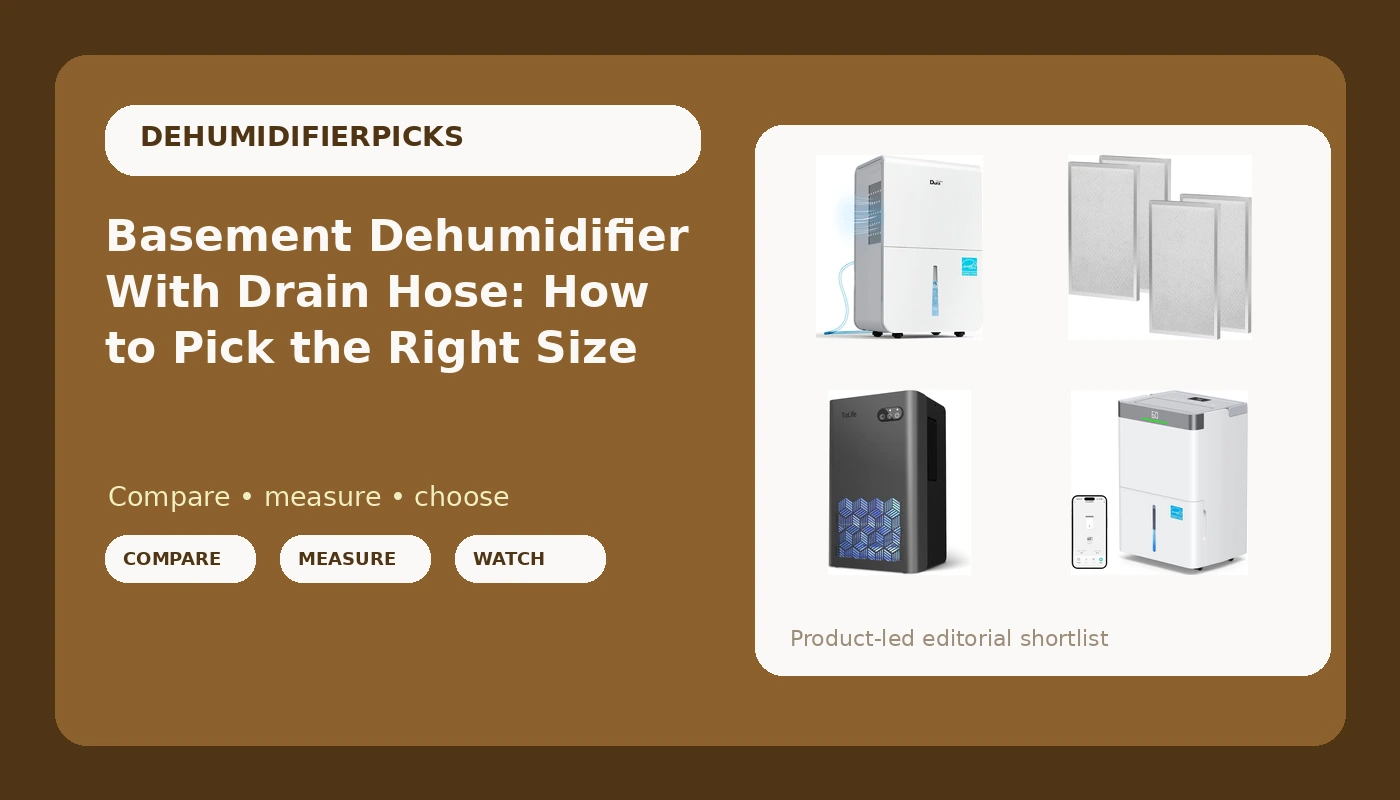
For a full basement, shop in the hose-drain class rather than the tank class. The 80 Pints 5000 Sq.Ft Home Dehumidifier with Drain Hose for Basement and the 50 Pint Smart Dehumidifier with Pump & WiFi both list continuous drainage, which is what keeps a unit running overnight without a human in the loop. The ToLife Dehumidifier is a tank unit built for a bedroom, closet, or small finished space, and the MERV-8 Filter Compatible with AlorAir Basement Dehumidifiers Sentinel HD55 is not a dehumidifier at all, it is a replacement filter for owners of that specific AlorAir unit. Match the machine to the room first, then decide how the water leaves the room.
Four useful options
| Model | Best fit | What stands out |
|---|---|---|
| 80 Pints 5000 Sq.Ft Home Dehumidifier with Drain Hose for Basement | Large open basement or whole-floor coverage | Highest pint class here, 5,000 square foot coverage claim, drain hose included |
| 50 Pint Smart Dehumidifier with Pump & WiFi, ENERGY STAR Dehumidifier for Basement Home up to 4,500 Sq.Ft, Continuous Drainage with 16.4 Ft | Mid-size basement where the water has to travel | Built-in pump, 16.4 foot continuous drainage line, ENERGY STAR listing, WiFi control |
| MERV-8 Filter Compatible with AlorAir Basement Dehumidifiers Sentinel HD55 | AlorAir Sentinel HD55 owners | MERV-8 filtration, made for that specific unit family |
| ToLife Dehumidifier, 1000 Sq Ft 95 oz Tank with Sleep Mode, Auto Shutoff | Bedroom, closet, or small damp room | 95 ounce tank, sleep mode, automatic shutoff |
The whole-floor workhorse: 80 Pints 5000 Sq.Ft Home Dehumidifier with Drain Hose for Basement
This is the size class you look at when the damp area is the entire footprint of the house, not one corner of it. The coverage figure in the name is a manufacturer claim, and I treat those the way I treat pint ratings: as an upper bound under ideal conditions, with open doorways and a finished ceiling eating into it. What matters more is the hose. A unit in this class pulls enough water that a tank becomes a daily chore, so the drain line is the feature that decides whether the machine works while you sleep. The name specifies a hose rather than a built-in pump, so plan on gravity drainage to a floor drain, sump pit, or laundry sink, or add a condensate pump if the only exit is uphill.
The smart mid-size unit: 50 Pint Smart Dehumidifier with Pump & WiFi, ENERGY STAR Dehumidifier for Basement Home up to 4,500 Sq.Ft, Continuous Drainage with 16.4 Ft
The pump is the reason to pick this one over the bigger unit in some houses. In a finished basement with no floor drain and no sump, gravity gets you nowhere, and a pump that lifts condensate to a utility sink or out a window is the difference between a working install and a bucket in the corner. The trade-offs are the ones I see on every service call in this category. Fifty pints is a lab figure, and in a cool basement with door gaps you should expect meaningfully less real removal, so a very large open space may still want two units or the larger class. The WiFi module is also the part most likely to need a reset, and it is not what dries the room. Buy this for the pump, not for the app.
The maintenance piece: MERV-8 Filter Compatible with AlorAir Basement Dehumidifiers Sentinel HD55
This one is in the list because a lot of basement dehumidifier searches end here by accident. It is a filter, and it only fits the AlorAir Sentinel HD55 family named in the listing. If you own that unit, a dirty filter is one of the quiet causes of poor performance: airflow drops, the coil ices or the unit runs longer than it should, and the machine gets blamed for something a consumable caused. If you do not own that unit, this is the wrong purchase entirely. Replacement filters are also where a cheap dehumidifier gets expensive over five years, so check the price and the replacement interval before you commit to a machine that depends on one.
Prices and availability may change. Product images, names, and retailer links are matched to verified listings. No current price, rating, stock status, or measured result is stated here without current evidence.
The small-room tank pick: ToLife Dehumidifier, 1000 Sq Ft 95 oz Tank with Sleep Mode, Auto Shutoff
Not every damp problem is a basement. A bedroom over a crawlspace, a closet against an exterior wall, a bathroom with no exhaust fan: those are small-volume problems, and a big compressor unit in a 120 square foot room is overkill that adds noise and heat. A tank unit makes sense here, and auto shutoff is the feature that keeps it from overflowing. Understand the arithmetic, though. A 95 ounce tank is roughly 0.74 gallons, so in genuinely humid weather you are emptying it more than once a day, and that is the whole argument for a hose in a basement. Sleep mode helps in a bedroom, but no dehumidifier is silent, and the compressor still cycles. Buy this for a small room, not for a wet 1,200 square foot basement.
Why the pint rating on the box is not what you get
Pint ratings are measured under standardized conditions, typically around 80 degrees Fahrenheit and 60 percent relative humidity. Your basement in October is not that. It might be 64 degrees and 72 percent relative humidity, which changes how much moisture the coil can pull and how often the compressor runs. The practical derate most technicians apply to a lab rating in a real, leaky house is 30 to 40 percent. That means a 50 pint machine may deliver something closer to 30 pints of actual removal per day in a cool basement with a stairwell door that never quite latches.
That is not a reason to distrust the spec. It is a reason to size up rather than size exactly. The usual rough guidance is that a moderately damp space wants the 50 pint class, a wet space with visible seepage or a musty smell wants the 70 pint class or higher, and a space with standing water or active seepage needs the water problem fixed before any machine can win. Coverage claims in square feet assume a ceiling height and a humidity level the manufacturer chose. Two smaller units in opposite corners often outperform one large unit in a big L-shaped basement, because air has to reach the machine to be dried.
Tank, hose, or pump, and the temperature question
Drainage is the decision people skip, and it is the one that determines whether the machine is still running at 3 a.m. in the worst week of the year. A tank is fine for a bedroom or a small room you pass through daily. A gravity hose is mandatory for a basement, because nobody enjoys hauling a full reservoir up a flight of stairs every morning, and a unit that shuts off on a full tank stops working exactly when the weather is worst. A built-in pump is for the house with no floor drain, no sump, and no downhill path, where condensate has to be lifted to a sink or a window.
Then there is the temperature split that most buying advice ignores. Compressor dehumidifiers, which is nearly everything in the consumer market, lose capacity as the air gets colder and can frost a coil in a cold basement. Desiccant units hold up better in cool spaces and are the right answer for an unheated cellar, at the cost of more energy per pint removed. If your basement stays above roughly 65 degrees, a compressor unit is the sensible buy. If it sits in the 50s all winter, you are shopping for the other technology, and no pint rating on a compressor box changes that.
- Measure the room, including ceiling height, and note whether the space is open or divided by walls.
- Read the room with a hygrometer for a few days, morning and evening, so you know the actual relative humidity range.
- Decide how the water leaves before you shop: floor drain, sump, sink, window, or tank only.
- Pick the pint class from the humidity reading, then size up one step for door gaps and a cool space.
- Confirm the drain setup and the filter or consumables before buying, since those costs continue after the sale.
Practical guidance for a real install
- Set the humidistat target between 45 and 50 percent. Lower is not better, it just runs the compressor longer for a dry-feeling room you will not notice.
- Keep windows and exterior doors closed while the unit runs. A dehumidifier fighting an open window is a machine pulling outside air through your house.
- Give the unit clearance on all sides and keep it away from the wall and from curtains, or you are recirculating its own exhaust.
- Check the drain line slope or pump discharge route monthly. A kinked or algae-clogged hose is the most common reason a hose-drain unit stops drying.
- Watch the first week with a bucket or a scale if you want the truth about performance, and note whether the unit restarts in the same mode after a power outage.
- Replace or clean the filter on the interval the manual states. A clogged filter on a machine like the AlorAir unit above looks exactly like a failing compressor.
Which option should you choose?
Choose the 80 Pints 5000 Sq.Ft Home Dehumidifier with Drain Hose for Basement when the damp area is a large open basement or a whole floor, you have a gravity drain path, and you want the biggest pint class in this group doing the work. Choose the 50 Pint Smart Dehumidifier with Pump & WiFi, ENERGY STAR Dehumidifier for Basement Home up to 4,500 Sq.Ft, Continuous Drainage with 16.4 Ft when the space is mid-sized and there is no downhill path for water, so the built-in pump and the 16.4 foot line are the features that make the install possible. Choose the ToLife Dehumidifier, 1000 Sq Ft 95 oz Tank with Sleep Mode, Auto Shutoff when the problem is one bedroom, closet, or small room and you are willing to empty a tank. Choose the MERV-8 Filter Compatible with AlorAir Basement Dehumidifiers Sentinel HD55 only if you already own that AlorAir unit and need its filter, not as a dehumidifier.
The limitation worth stating plainly: coverage figures, pint ratings, and ENERGY STAR listings are manufacturer or program claims, and nothing here is a measured performance result for your house. Two identical basements can behave differently based on grade, drainage, and how the space is used.
The bottom line
Buy the drainage first and the pint rating second. A basement dehumidifier with drain hose that runs unattended all summer beats a bigger machine that shuts off every night on a full tank. Match the class to the room, expect the lab rating to shrink in a real house, and treat filters and hose routing as part of the purchase rather than an afterthought. If the space is small, the ToLife unit is a reasonable small-room answer. If it is a full basement, choose between the 80 pint hose unit and the 50 pint pump unit based on where the water can physically go.