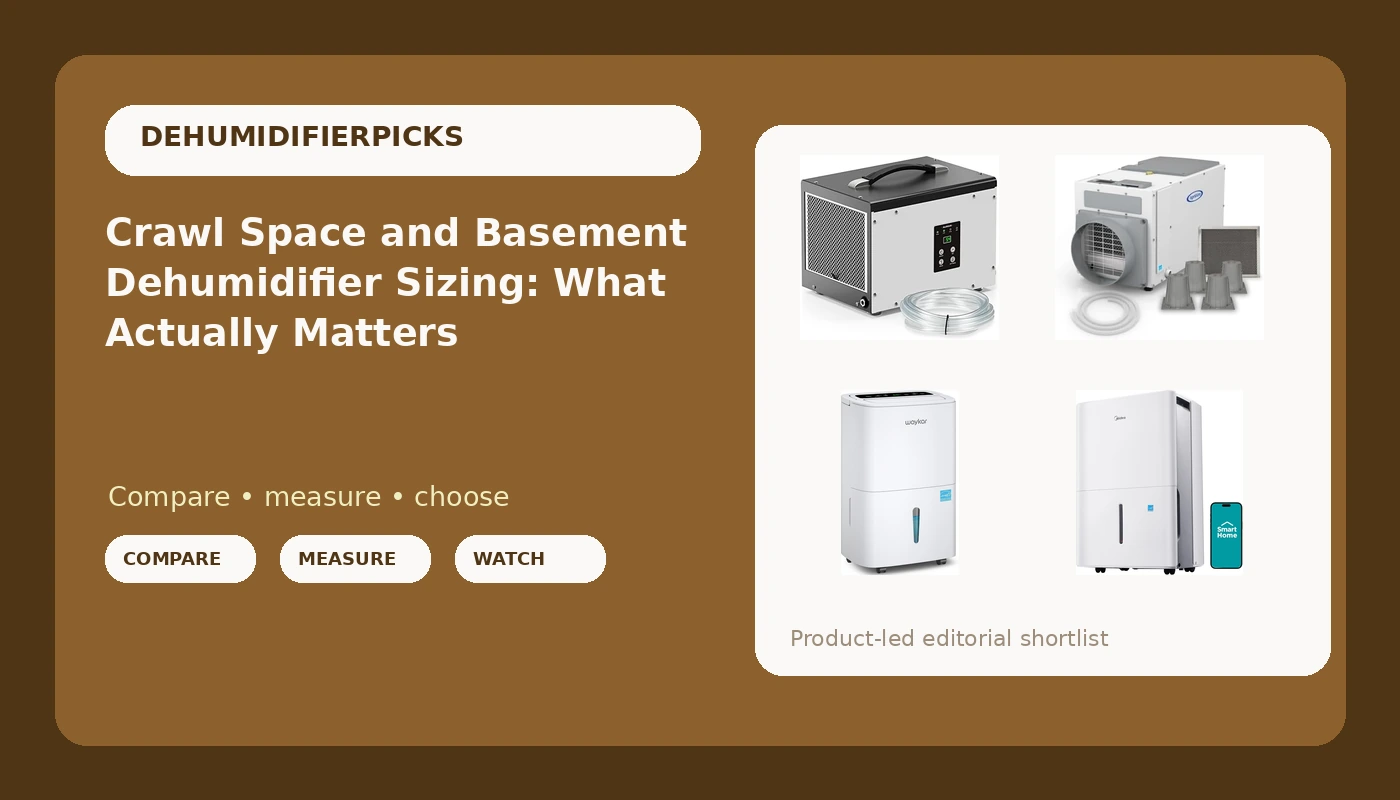
I have pulled moldy drywall out of enough Louisiana homes to know that the dehumidifier is rarely the first thing a homeowner thinks about and almost always the thing they wish they had bought sooner. A crawl space and basement dehumidifier is not a bedroom appliance with a bigger tank. It runs in the worst air in the house, usually in the dark, usually unattended, and it has to keep working when nobody is standing there to empty it. The mistake I see most often is sizing by the number printed on the box. A unit rated for 4,500 square feet sounds like it covers a whole house, but that rating comes from a lab at a temperature and humidity level your basement will not hold in July. This explainer walks through what the four machines below actually are, what their ratings mean, and how the tank, the hose, and the pump should drive your decision.
Related: How to Run a Dehumidifier Drain Hose When You Have No Floor Drain →
Quick answer
Match the machine to the drain first, then to the square footage. If the unit will sit in a crawl space below the floor line, where gravity cannot carry condensate away, you want a model with a built in pump. If you are treating a whole house or a commercial space up to roughly 5,500 square feet, the 100 pint class with a complete kit is the right shelf to shop. For a finished basement of a few thousand square feet, an 80 pint or 50 pint portable with a hose drain covers the job. If the space sits below about 60 degrees through the winter, remember that compressor output falls off in cold air and the pint rating on the box no longer describes what the unit will pull.
Four useful options
| Model | Best fit | What stands out |
|---|---|---|
| ALORAIR 70 PPD Dehumidifier with Pump for Crawl Space and Basement | Crawl spaces and low drain points | Built in pump and a crawl space class rating |
| AprilAire E100 Pro Dehumidifier Bundle - 100 Pint Whole House Dehumidifier - Full Complete Kit - Crawl Spaces, Basements, Whole Homes, Commercial up to 5,500 sq. ft - 5 Year Warranty Included | Whole house and commercial drying | 100 pint capacity sold as a complete kit with a five year warranty |
| Waykar 80 Pints 2025 Energy Star Dehumidifier for Home up to 5,000 Sq. Ft, Ideal for Basement, Bathroom and Large Room with Drain Hose, Portable, Auto Defrost and Self-Drying | Large basements and open floors | 80 pint rating with a drain hose, auto defrost, and self drying |
| Midea 50 Pint Dehumidifier for Basement, 4,500 Sq. Ft, Energy star | Mid size basements and single rooms | 50 pint Energy Star unit in the portable size class |
The crawl space and low drain option: ALORAIR 70 PPD Dehumidifier with Pump for Crawl Space and Basement
A crawl space is the hardest place in the house to run a dehumidifier, and it has nothing to do with the machine's rating. The unit sits low, the condensate has nowhere to go, and the space is often sealed and forgotten. That is where a pump earns its place: it lifts water to a utility sink, a condensate line, or a floor drain at grade instead of asking you to crawl in twice a day with a bucket. The trade off is that a pump is one more part that can clog with biological growth over a season, so it needs a flush and a check on the discharge line at the same time you clean the filter.
The whole house option: AprilAire E100 Pro Dehumidifier Bundle - 100 Pint Whole House Dehumidifier - Full Complete Kit - Crawl Spaces, Basements, Whole Homes, Commercial up to 5,500 sq. ft - 5 Year Warranty Included
A 100 pint machine is not a portable appliance you roll from room to room. It belongs to a different kind of job: a whole floor, a house with no central air in the back rooms, or a commercial space that holds water in the air all year. That capacity also means more condensate, which means the drain plan matters even more than it does on a 50 pint unit. A kit that arrives complete saves you the second trip for the hose, the fittings, and the clamps, and a five year warranty on a machine this size is worth reading in full before you buy, particularly the parts about who pays for labor.
The large basement option: Waykar 80 Pints 2025 Energy Star Dehumidifier for Home up to 5,000 Sq. Ft, Ideal for Basement, Bathroom and Large Room with Drain Hose, Portable, Auto Defrost and Self-Drying
Auto defrost and self drying sound like marketing until you run a unit through a Gulf Coast winter. When coil temperature drops below freezing, frost builds on the evaporator and the machine stops moving water until it thaws. A defrost cycle handles that automatically, and a self dry cycle pushes air across the coil after shutdown so you are not leaving a wet, biologically active surface sitting in a dark basement. The hose in the box matters too, because a gravity drain is the difference between a machine that runs all month and a machine that shuts off on a full tank float at 3 a.m.
The mid size basement option: Midea 50 Pint Dehumidifier for Basement, 4,500 Sq. Ft, Energy star
The 50 pint class is where most homeowners should start, and it is also where most homeowners get oversold. A 50 pint compressor unit in a sealed, finished basement of 1,200 to 1,800 square feet with a hose drain will hold a reasonable humidity setpoint through a humid summer. Put the same unit in an open, leaky 3,000 square foot basement with a damp crawl space feeding it, and it will run continuously and lose ground. The square footage on the listing is a ceiling for the class, not a promise about your house.
Prices and availability may change. Product images, names, and retailer links are matched to verified listings. No current price, rating, stock status, or measured result is stated here without current evidence.
What the pint rating actually means
Pints per day is measured under a fixed reference condition, traditionally 80 degrees Fahrenheit at 60 percent relative humidity. Your basement in February is not 80 degrees, and your basement in August may be well above 60 percent humidity. Both directions move the number. In cold air, a compressor unit's output falls off sharply because the coil runs colder and frost forms faster. In very humid air, a compressor unit can pull more than its rating for a while, which is why the same machine feels impressive in July and useless in December.
That is the reason I tell homeowners to cut the box rating by 30 to 40 percent when they size a real space, then check whether the result still covers the square footage and the dampness they actually have. If the arithmetic comes up short, you have two honest options: buy the next class up, or accept that one machine will not treat the whole basement and plan for a second unit or a dedicated crawl space unit. Nobody enjoys hearing the second part. It is still cheaper than replacing joists.
There is also a temperature split that most reviews skip. Compressor dehumidifiers win in warm spaces. Desiccant dehumidifiers win in cold basements and unheated crawl spaces, where they keep working when a compressor is spending half its runtime in defrost. If your space stays under about 60 degrees for months at a time, that distinction matters more than the pint number.
Drain, pump, or tank: the decision that outlasts the spec sheet
The tank is the part of the product that decides whether the machine keeps working. A float switch shuts the compressor down when the tank fills, and in a wet month a mid size unit can fill a tank in a day. If you are not home to empty it, you own a machine that quits at the worst possible moment and restarts at whatever humidity level the space has reached by the time you get to it.
A gravity hose fixes that, provided the outlet is lower than the unit and the run has continuous fall. A built in pump fixes it when the outlet is above the unit, which is the normal situation in a crawl space. Whichever route you take, the line needs a trap or a steady slope, no low spots where water sits, and a discharge point that will not freeze. I install hose kits as often as I install units, and I have never met a homeowner who missed emptying a bucket.
- Measure the space and note whether it is sealed or open to a crawl space.
- Check the worst month's humidity with a hygrometer rather than guessing from feel.
- Cut the box pint rating by 30 to 40 percent and see if the result still covers the space.
- Find the drain point first and decide between gravity, a pump, or a tank.
- Confirm the space temperature through winter before committing to a compressor design.
Practical guidance
- Put a cheap hygrometer in the space and log it for a week before you buy anything. A humidistat on the unit can read 10 to 15 percent off from the actual air.
- Run the drain line with continuous fall and no low spots, and insulate or heat any portion that passes through a freezing area.
- Clean the filter on the schedule the manual gives you, and price replacement filters before you commit to a model that uses a proprietary one.
- After a power outage, check that the unit restarted in dehumidify mode rather than fan only. A machine that quietly blows air for a week is worse than one that is off.
- If you want to know what the machine costs to run, put a watt meter on it for a week and multiply the kilowatt hours by your rate. Energy Star listings help you compare, but the meter tells you your number.
Which option should you choose?
Choose the ALORAIR 70 PPD Dehumidifier with Pump for Crawl Space and Basement when the unit has to live below the floor line and lift its own condensate. Choose the AprilAire E100 Pro Dehumidifier Bundle - 100 Pint Whole House Dehumidifier - Full Complete Kit - Crawl Spaces, Basements, Whole Homes, Commercial up to 5,500 sq. ft - 5 Year Warranty Included when you are treating a whole house or a commercial space and want the kit and the warranty in one purchase. Choose the Waykar 80 Pints 2025 Energy Star Dehumidifier for Home up to 5,000 Sq. Ft, Ideal for Basement, Bathroom and Large Room with Drain Hose, Portable, Auto Defrost and Self-Drying when you need large basement capacity, a hose in the box, and defrost for shoulder season cold snaps. Choose the Midea 50 Pint Dehumidifier for Basement, 4,500 Sq. Ft, Energy star when you have a finished basement in the portable size class and a drain you can reach.
One caveat on all four: the square footage figures come from the listings, and they assume conditions your house may not match. The pint rating is a lab number, the warranty terms are worth reading in full, and no listing can tell you how a machine behaves in your specific crawl space. Size from your own hygrometer readings and your own drain situation, and treat the box numbers as a starting point rather than an answer.
The bottom line
A basement or crawl space dehumidifier is a drainage decision wrapped in a capacity decision. Get the drain right, gravity where you can and a pump where you cannot, and the machine will run unattended through the worst month of the year. Then size the capacity honestly, cutting the box rating by 30 to 40 percent to account for real air and real temperatures, and buy the class that still covers your space after the cut. The 50 pint portable handles a finished basement, the 80 pint unit handles a large one, the 100 pint kit handles a whole house, and the pump equipped unit handles the crawl space where nothing else can drain.