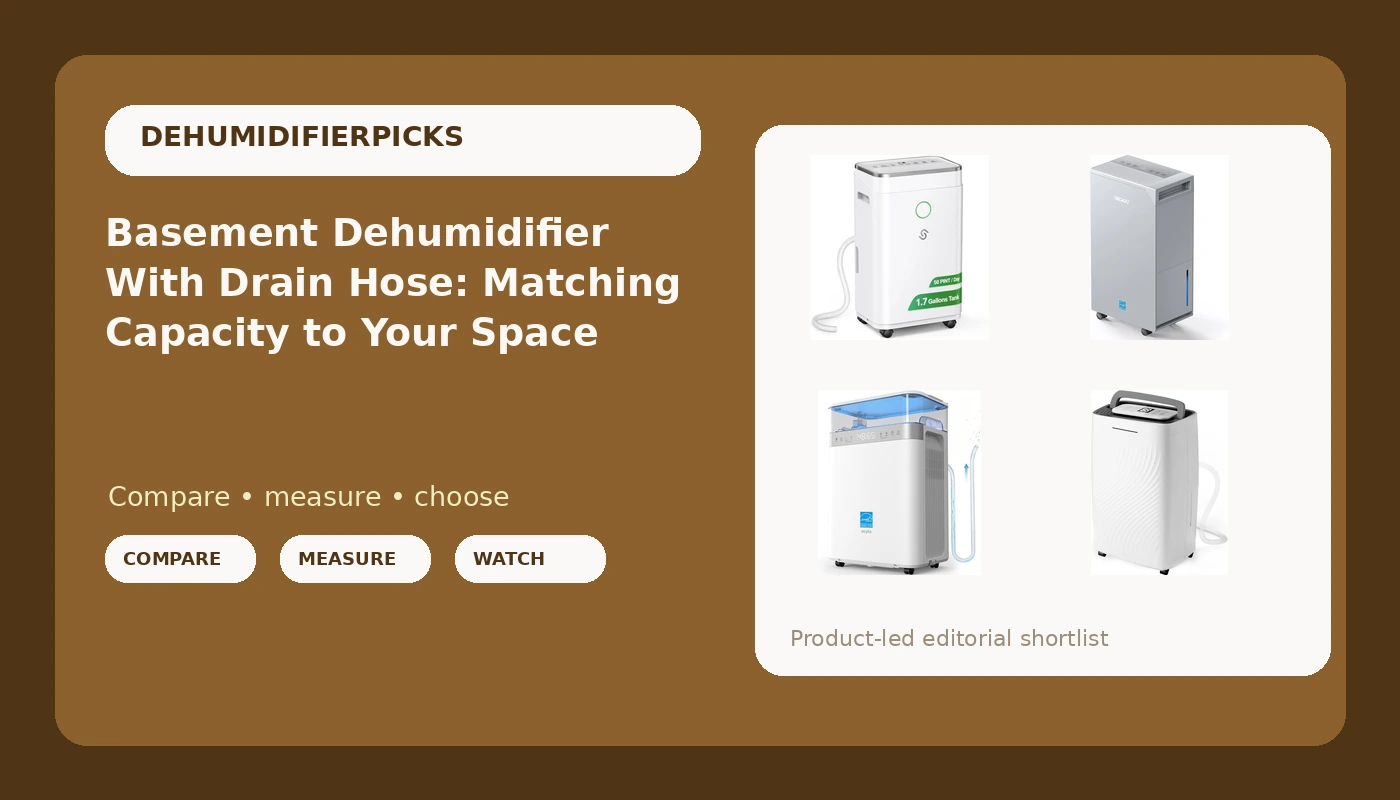
If you have ever opened a basement door in July and felt the air thick enough to drink, you already know the pint number on the box is not the whole story. A basement dehumidifier with drain hose keeps working when nobody is home to empty a bucket, which is the difference between a machine that manages humidity and a machine that quits at 2 a.m. on the wettest night of the year. The problem is that 50 pint, 81 pint, and 100 pint are measured under test conditions your basement will never match, and coverage claims like 4,500 or 5,500 square feet assume a sealed, empty room. This explainer goes through four currently listed units, what actually separates them, and how to pick the one that fits your space rather than the one with the biggest sticker.
Related: How to Run a Dehumidifier Drain Hose to a Floor Drain →
Quick answer
Size the unit to the dampness and the volume of the space, then let the drain path decide the model. All four units below ship with a drain hose, so the meaningful differences are the pint rating, the coverage claim, and whether the unit has a built-in pump to lift water uphill. Choose a gravity hose model when a floor drain, sump pit, or slop sink sits lower than the unit. Choose a pump model when the only drain is above it or on the far side of the room.
4 useful options
| Model | Best fit | What stands out |
|---|---|---|
| 81 Pint Dehumidifier, 5500 Sq.Ft Dehumidifier for Basement with Drain Hose | Large open basements with a floor drain | 81 pint per day rating and a 5,500 sq ft coverage claim, with a drain hose included |
| 5000 Sq.Ft Dehumidifier, 100 Pint Smart Humidity Control, Drain Hose | Big, warm, very humid spaces where app control matters | The highest pint rating in this group at 100 pints per day, plus smart humidity control and a hose |
| avylo Dehumidifier for Basement with Pump and Hose, Max 90 Pints/D, White | Basements where the drain is uphill or far away | A built-in pump and hose, rated to a maximum of 90 pints per day |
| Dehumidifier for Basement with Drain Hose 4500 Sq.Ft - 50 Pint 1.7 gal Tank | Single rooms and smaller basements | The smallest capacity here at 50 pints per day, with a 1.7 gallon tank as well as a hose |
Largest coverage: 81 Pint Dehumidifier, 5500 Sq.Ft Dehumidifier for Basement with Drain Hose
The coverage number is the part to treat with suspicion. A 5,500 square foot claim describes a large, open, reasonably dry space, not a finished basement with three closed doors and a carpet that holds moisture. If your basement is divided into rooms, the unit only conditions the air it can reach, and closed doors turn one 1,500 square foot problem into three separate ones. The drain hose is what makes this unit practical: run it to a sump pit or floor drain with a continuous downward slope and the machine handles the wet season on its own. Buy a hose clamp and check the outlet height before you commit, because gravity only works if the drain is lower than the port.
Highest capacity: 5000 Sq.Ft Dehumidifier, 100 Pint Smart Humidity Control, Drain Hose
More pints per day means the compressor can move more moisture when the air is warm and saturated, which is exactly the condition a Gulf Coast basement sits in from May through September. The trade-off is the smart layer. App control and Wi-Fi modules are separate electronics from the refrigeration circuit, and in my experience they are the first thing to act up after a voltage sag or a router change. That does not make the feature useless, but it does mean you should set the onboard humidistat to a sane target and treat the app as a convenience rather than the control system. Verify the reading with a standalone hygrometer before you trust either one.
Built-in pump: avylo Dehumidifier for Basement with Pump and Hose, Max 90 Pints/D, White
A pump changes what is possible in a basement that has no floor drain, which describes a lot of older housing stock. Instead of parking the unit next to a drain you do not have, you route the hose up to a sink or out a window and let the pump do the lift. Two cautions. First, pump lift height is finite, so keep the run short and the rise modest. Second, condensate pumps grow biofilm, and a clogged pump either trips a safety float or overflows. Flush the pump line at the start of the season, before the humid months, rather than after you find water on the floor.
Tank and hose: Dehumidifier for Basement with Drain Hose 4500 Sq.Ft - 50 Pint 1.7 gal Tank
A 1.7 gallon tank sounds generous until you do the arithmetic. In genuinely humid air, a 50 pint unit can fill that tank in less than a day, and most units shut off the compressor when the float trips. That is the failure mode nobody thinks about: the machine is off for eight hours while you are at work, the basement drifts back toward saturation, and you come home to a tank that needs emptying twice a day in the worst weeks. The hose solves it. Use the tank only when the hose is impractical, such as a bedroom or a closet where a drain line would be a trip hazard.
Prices and availability may change. Product images, names, and retailer links are matched to verified listings. No current price, rating, stock status, or measured result is stated here without current evidence.
Pints per day versus square footage
Pint ratings come from a standardized test, which means they are comparable to each other in a way that marketing copy is not, but they are still measured under fixed temperature and humidity conditions. Your basement is not a test chamber. It has door gaps, a concrete floor that wicks, a dryer vent, and a stairwell that acts as a chimney. The practical consequence is that real-world output runs well below the rated number, and the gap widens as the space gets leakier and cooler.
Square footage claims are looser still. They are a shorthand the manufacturer chooses, not a measurement standard, and two brands can attach very different numbers to the same compressor. A better sanity check is to think about moisture load rather than floor area. A 600 square foot basement with a cracked floor and no vapor barrier can demand more from a dehumidifier than a 1,200 square foot finished space with a sealed slab and a working sump. If you are unsure, buy for the dampest scenario and use the humidistat to keep the unit from overworking.
Compressor versus desiccant, and why temperature decides
Portable dehumidifiers fall into two families. Compressor units work like a small air conditioner: they condense moisture on a cold coil and drain it away. They are efficient in warm air and lose effectiveness as the space gets colder, which is why a cool basement in January can leave a compressor unit running constantly for very little water. Desiccant units use a rotating wheel and heat to pull moisture out of the air, and they hold up better in cold rooms, at the cost of more energy per pint in warm conditions.
Temperature is the deciding variable, and most buying advice skips it entirely. If your basement stays above roughly 65°F through the damp season, a compressor unit is the usual answer. If it sits in the 50s for months, look at desiccant before you spend money on capacity you cannot use. The units in this group are aimed at typical warm basement duty, so if you are heating a crawlspace or a cold cellar, that is a different shopping list.
- Measure the room and note the temperature range across the year, not just in July.
- Find every possible drain: floor drain, sump pit, laundry standpipe, utility sink, or window.
- Decide whether gravity can carry the water or whether you need a pump to lift it.
- Size the pint rating with a derate in mind rather than taking the box number at face value.
- Plan to verify the humidistat with a separate hygrometer and set your target between 45 and 50 percent.
Practical guidance before you buy
- Slope the drain hose continuously downhill; any sag becomes a water trap that stops flow.
- Keep the unit a few inches off the wall so the intake and exhaust are not blocked.
- Set the humidistat to 45 to 50 percent relative humidity; lower is not healthier and it costs more to run.
- Check or rinse the filter monthly during the wet season, and price replacement filters before you buy.
- After a power outage, confirm the unit restarted in dehumidify mode rather than fan only.
Which option should you choose?
Choose the 81 Pint Dehumidifier, 5500 Sq.Ft Dehumidifier for Basement with Drain Hose when you have a large, open basement and a floor drain or sump pit that sits below the unit, so a gravity hose can run all season. Choose the 5000 Sq.Ft Dehumidifier, 100 Pint Smart Humidity Control, Drain Hose when the space is big, warm, and genuinely wet, and you want the highest pint rating here plus app visibility, with the understanding that the onboard controls should still do the real work. Choose the avylo Dehumidifier for Basement with Pump and Hose, Max 90 Pints/D, White when there is no drain below the unit and you need a pump to push condensate up to a sink or out a window. Choose the Dehumidifier for Basement with Drain Hose 4500 Sq.Ft - 50 Pint 1.7 gal Tank when the problem is one room or a smaller basement, and a 50 pint unit with a tank plus a hose covers it without overspending on capacity.
None of these listings lets you audit the test conditions behind its pint or coverage number, and ratings are not perfectly comparable across brands and vintages. Treat every figure here as a starting point for your own sizing, and confirm the current specifications and warranty terms on the listing before you buy.
The bottom line
The pint rating gets the attention, but the drain path decides whether a dehumidifier actually works in a basement. A machine that fills a tank and shuts off is not managing your humidity, it is managing it until the tank fills. Pick the coverage and capacity that match your space after a realistic derate, then pick the model whose drain setup fits the plumbing you already have: gravity hose for a large basement with a floor drain, a pump model when the water has to go up, and a tank-plus-hose unit when the space is small enough that either method works.