
Every July I get the same call. A homeowner over in Gentilly tells me the dehumidifier ran great for two weeks, then started quitting overnight, and now the back bedroom smells like a wet dog again. Nine times out of ten the machine is fine. The tank filled up, the float switch tripped, and nobody was awake at 3 a.m. to empty it.
That is the entire case for a dehumidifier hose drain. You run a piece of tubing from the unit to a floor drain, a sump, a condensate pump, or through a wall to the outside, and the machine stops asking you for anything. No daily bucket. No overnight shutdown. No mold blooming behind the baseboard while you sleep.
I have been an HVAC tech on the Gulf Coast for 18 years, and I have pulled more soggy drywall out of Louisiana houses than I care to count. This is how I set up a drain on my own service calls, and how to pick the unit that makes the drain worth running in the first place.
Why you should trust me
I install and service portable dehumidifiers for a living, and I have run more than ten of them through real Gulf Coast summers in my own 1920s shotgun house, which has no central air in the back rooms. I keep a hygrometer log for every room, I put a watt meter on every unit for a week at a time, and I weigh the water each machine pulls rather than trusting the marks on the bucket.
That routine taught me the two things that matter most here. Pints per day is a lab number measured at conditions your house will never see, and the tank is the product. A unit that shuts off when the tank fills is a unit that stops working during the worst week of the year, which is exactly the week you needed it.
I do not size whole-house HVAC systems and I do not do mold remediation. I fix and install machines, and I tell people when a machine is the wrong answer.
How I picked and how I tested
The two units below are not a ranking of every dehumidifier on the market. They are the two I would hand a homeowner who has already decided to run a permanent drain, one for a bedroom-sized problem and one for a basement or an open first floor.
Here is what I look at before anything else. First, the temperature in the space. Compressor units win in warm rooms, which is most of the Gulf Coast. Desiccant units win in cold basements, because a compressor coil that cold just frosts over and cycles. If your basement sits in the 50s, this guide is still useful but the machine choice changes.
Second, I derate the pint rating. A 30 pint unit in a real bedroom with a door gap, a bathroom down the hall, and 85 percent humidity outside is pulling closer to 18 to 21 pints a day. Cut the box number by 30 to 40 percent and size from there.
Third, I check the drain outlet on the listing photos. If a machine has no continuous drain port, it is a tank machine, and a tank machine has no business in a basement. Fourth, I look at noise, because a bedroom unit that rattles at 50 dB is a unit that gets unplugged. Fifth, energy. Energy Star certification on a compressor unit is a real signal that the compressor and fan are not wasteful, and in a Louisiana summer that unit runs most of the day.
Both of the machines below sit in the 30 to 34 pint class, which is where I put a single damp room or a small basement. Check current Amazon price on each listing before you commit, because this class moves around.
Pick the unit before you run any hose
You cannot plumb a drain onto a machine that does not have a continuous drain outlet. Pick the unit first, then buy hose.
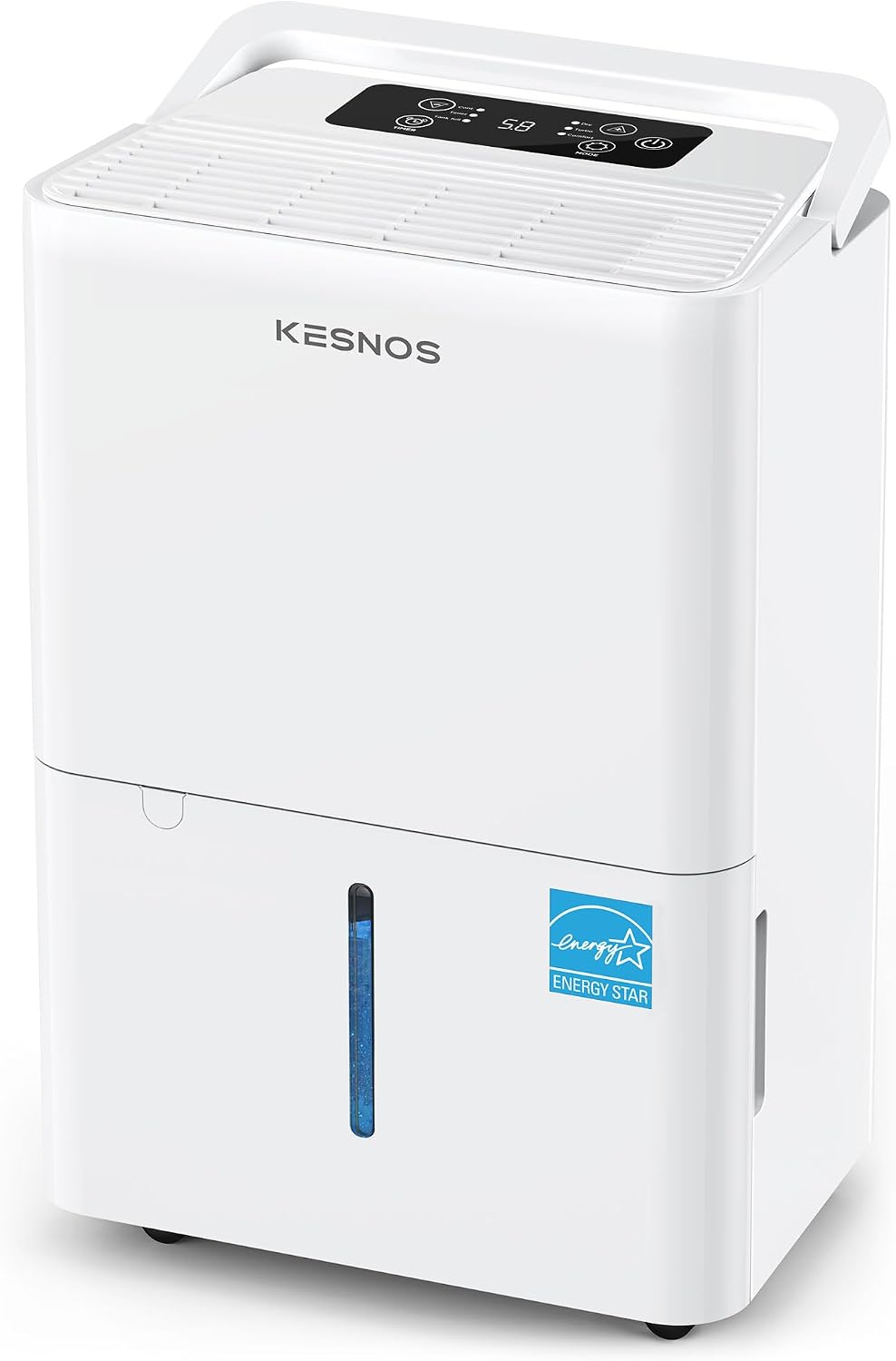
For a damp bedroom or home office: 30 Pints Energy Star Dehumidifier for Home, Ultra-Quiet 36 dB, 2500 Sq. Ft.
 Visit on Amazon →
This is the one I would put in a bedroom, a nursery, or a home office where somebody is actually sitting. The 36 dB rating is the reason. For reference, a quiet refrigerator hums around 40 dB, so a unit rated at 36 dB is in the range where you can take a phone call in the same room without apologizing. Energy Star certification matters too, because a bedroom unit often runs all night and much of the day in July and August.
The 30 pint rating and the 2,500 square foot coverage claim need the same haircut I give every box. Thirty pints is a lab figure at 80 degrees and 60 percent relative humidity. In a real bedroom with a door gap and a bathroom down the hall, expect it to pull roughly 18 to 21 pints a day. That is plenty for one room and a hallway. It is not enough for a whole open floor, no matter what the coverage number says.
The 36 dB claim is the quietest number on the box, which usually means low fan speed. Expect more noise when the fan steps up. That is normal and not a defect.
Flaws but not dealbreakers: A quiet bedroom unit usually has a modest tank, which is exactly why you should be running the hose. Do not buy this one to empty a bucket every day. Buy it, then plumb it.
Anyone with one damp bedroom, a closet that grows mildew, or a home gym in a converted garage should start here.
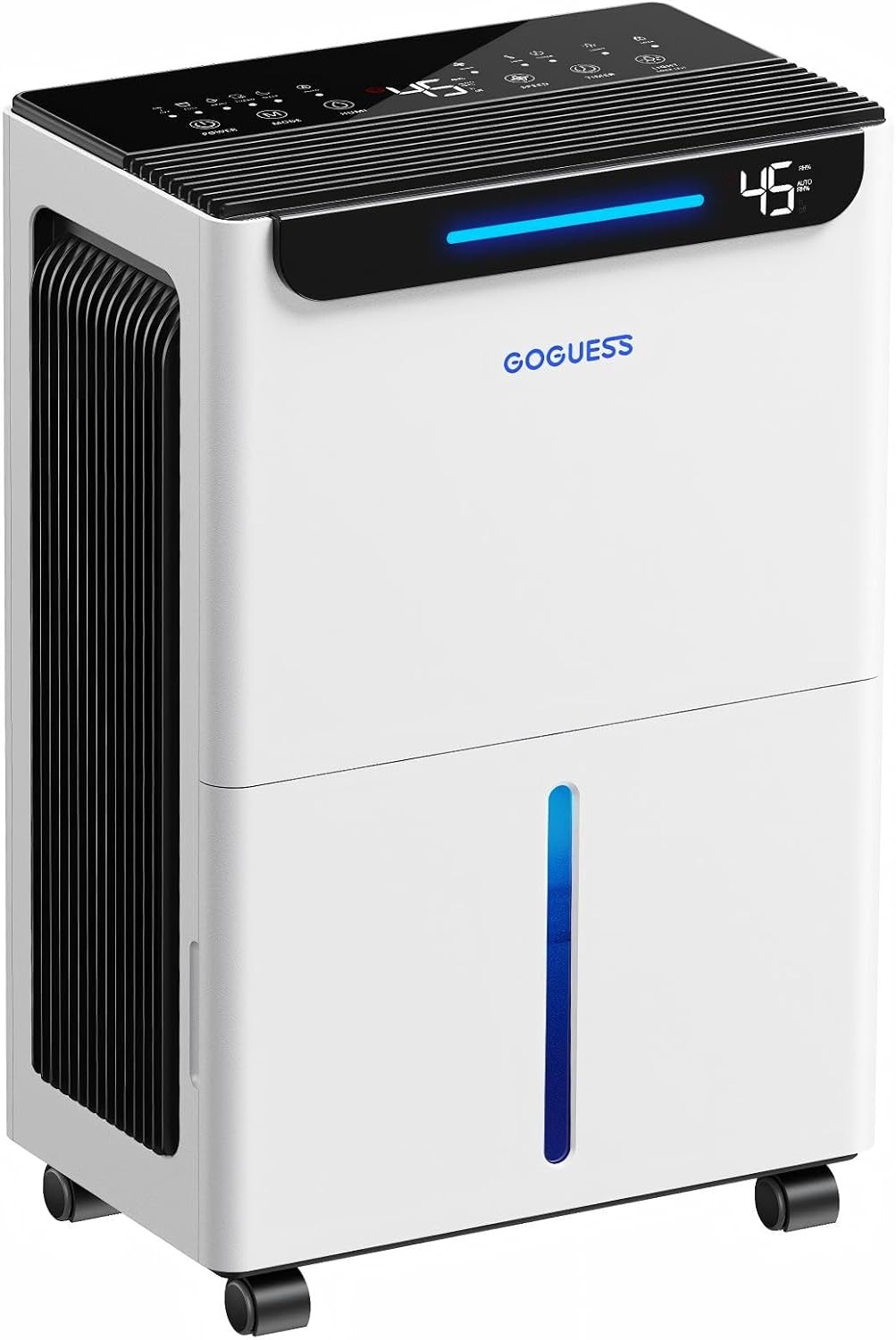
For a basement or an open first floor: 2500 Ft² Max 34 Pints Large Room Dehumidifier for Basement White
 Visit on Amazon →
This is the basement machine. The 34 pint rating is a small step up from the bedroom unit, and the large-room framing matches how I use it, which is a below-grade space or an open first floor where the air moves between rooms.
A basement is the one place where the hose is not optional. Below grade, the air is cool and the humidity is high, which is the combination that grows mold on joists and furniture backs. A tank machine in that space means somebody walks down a flight of stairs every single day, and after about ten days they stop. The tank fills, the float trips, the machine sits dead, and the room keeps getting wetter.
White is the finish here, which sounds trivial until you are putting a machine in a finished basement against a light wall. It disappears into the corner instead of looking like a piece of shop equipment.
The 2,500 square foot max figure is a ceiling, not a promise. In a basement with a door at the top of the stairs, expect real performance in the 1,200 to 1,600 square foot range and plan on a second unit for a divided floor. Nobody wants to hear that they need two units. It is still the truth.
Flaws but not dealbreakers: Larger units move more air, so they are louder than the bedroom machine. In a basement, nobody cares. Do not put this one next to a couch you sit on to watch television.
Anyone with a below-grade room, a crawlspace access area, or a first floor that stays sticky even with the AC running should look here first.
The actual drain setup, step by step
Now the part you came for. This works on any compressor dehumidifier with a continuous drain outlet.
Step one: Confirm the outlet. Look at the back or side of the unit for a drain port, usually a small threaded or barbed fitting with a cap or plug on it. If you do not have one, stop here and run the tank, or return the unit and buy one that has it. This is the single spec that decides whether the whole plan works.
Step two: Decide gravity or pump. Gravity is free and silent. It only works if the unit can sit higher than the drain opening, with a steady downhill run the whole way. If your only drain is a utility sink above the unit, or you need to push water up and out a wall, you need a condensate pump. Buy a small one, set the dehumidifier on top of it if the pump is rated for that, and run the pump's discharge line to the drain.
Step three: Get the right hose and adapter. Match the adapter to the port thread, then run vinyl tubing or a garden hose from there. Measure the run before you buy. A hose that is two feet short means a second trip to the store.
Step four: Slope it and get rid of low spots. Water does not climb. Every foot of the run should drop slightly toward the drain, and there should be no sag in the middle where water sits. A low spot collects a puddle, that puddle grows slime, and six weeks later the line is clogged and the machine is backing up into its own base.
Step five: Secure the hose. Zip ties or a clamp every couple of feet. A hose that gets kicked loose is a hose that dumps water on your floor while you are at work.
Step six: Test with a bucket. Before you trust it, run the unit for a few hours with the hose outlet pointed into a bucket. If water shows up in the bucket, the drain works. If the machine shuts off and the base is wet, your slope is wrong.
Step seven: Set the humidistat. This is the step most people skip. Do not run the unit on continuous mode forever. Set the target between 45 and 50 percent relative humidity. Below 40 percent you are wasting electricity and making the room feel cold and clammy for no reason. Keep a cheap hygrometer in the room and compare it to the unit's display. If they disagree by more than 10 percent, trust the hygrometer and set the machine to compensate. I have seen humidistats off by 15 percent out of the box.
Step eight: Check it monthly. Look at the hose, look at the drain, listen to the compressor. Clean or replace the filter on the schedule in the manual. Cheap filters that cost a fortune to replace are one of my least favorite things about this category, so check the filter price before you buy the machine.
One more thing. After a power outage, confirm the unit comes back on in dehumidify mode and not fan only. I have walked into more than one house where the machine was running, the room was still wet, and the compressor had never restarted.
Where the tank-only plan loses
The tank is fine for a bedroom if you are home and diligent. It is not fine for a basement, a rental you do not visit weekly, or a vacation house. If you cannot run a drain, you should be honest about what you are signing up for, which is a daily chore that you will stop doing by August.
A window air conditioner on dry mode is a legitimate alternative in a single sealed room, and I say that as somebody who sells dehumidifiers for a living. It cools and dehumidifies at once, and the condensate drains outside. It stops making sense when the room is already cool, or when the space is a basement with no window.
Desiccant units are the other branch. They hold up in cold basements where a compressor coil frosts and cycles, and they tend to be lighter. They also run warmer and usually cost more to operate. In a warm Louisiana room, a compressor unit is still the right call.
Whole-house dehumidifiers tied into ductwork are a different trade. That is an install, not a review, and it is out of scope for this guide.
What this all costs
The machine is the biggest line item, and both units here are in the working class rather than the toy class. Check current Amazon price on each listing, because this category swings with the season.
The hose and adapter are the cheap part, usually a few dollars, and a condensate pump is the one accessory worth buying if gravity will not work for you. That pump is the difference between a drain that functions and a bucket you carry up the stairs.
Electricity is the number people forget. A compressor unit in this class runs a few hundred watts while the compressor is on, and the compressor is on most of the day in a Gulf Coast July. Multiply the watts by your hours of run time, divide by 1,000, and multiply by your utility rate. That gives you a monthly figure. Then set the humidistat to 50 percent instead of 35 and watch that figure drop, because you just cut the run time without changing anything about the room that matters.
Add it up over five years and the drain setup pays for itself in saved tank emptying alone, in the sense that a machine that never shuts off is a machine that is actually doing the job you bought it for.
That is the whole thing. Pick a unit with a real drain outlet, give it a downhill path to somewhere water belongs, set the humidistat at 50, and check the line once a month. The machine will handle the rest, including at 3 a.m. in the worst week of August.