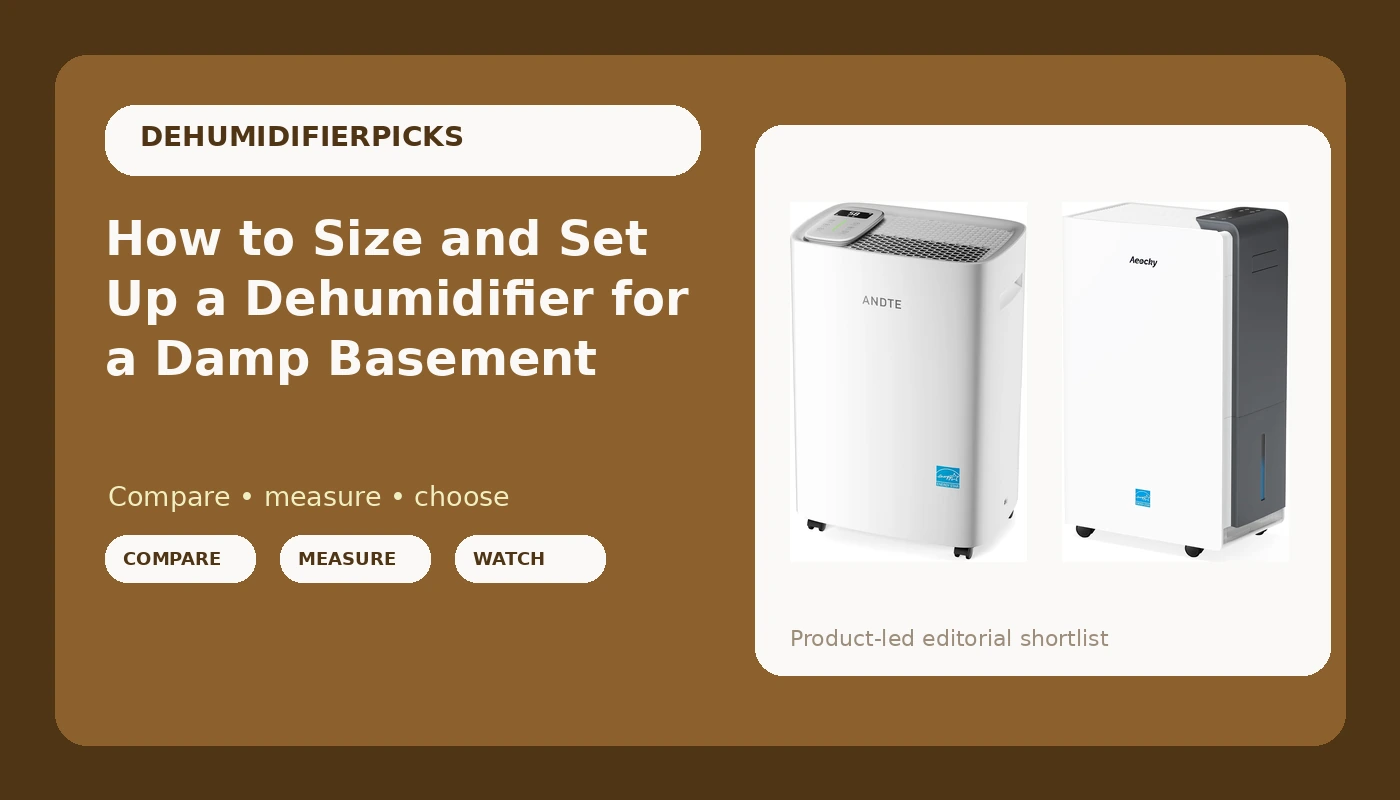
Most dehumidifier advice starts with a chart. Twelve hundred square feet, thirty pints, done. That chart is why people buy a small unit for a wet basement, run it for a week, and then tell me the machine was junk. Knowing how to size a dehumidifier for a basement starts with throwing out the square footage number and thinking about water instead.
I am Carlos. I have been an HVAC tech in New Orleans for 18 years, and I have pulled more moldy drywall out of Louisiana homes than I care to count. I install and service dehumidifiers for a living. My own house is a 1920s shotgun with no central AC in the back rooms, and those rooms sit above 60% relative humidity for weeks at a time in July and August. Nothing in that house dries on its own.
What follows is the same walkthrough I give a homeowner standing in a damp basement: how to size the machine, where to put it, how to drain it, what to set the humidistat to, and when to admit that one unit is not enough.
Why you should trust me
I have been in the trades for 18 years, most of it on the service side, which means I see dehumidifiers long after the warranty has expired and the honeymoon is over. I keep a hygrometer log, a watt meter, and a bucket routine: I weigh the water a unit actually pulls instead of trusting the pint rating on the box. I have run more than ten portable units through real Gulf Coast summers, and I have installed hose drain kits in basements where the homeowner was emptying a tank twice a day and had stopped noticing they were doing it.
I do not sell dehumidifiers. I get paid to keep houses dry, and sometimes the honest answer is that you do not need the machine you walked in wanting to buy.
How I picked these two
I picked from machines that meet three field conditions. First, a real hose drain option, because a basement unit with only a tank is a unit that quits at 3 a.m. in the worst month of the year. Second, a pint rating that matches the water load rather than the marketing panel. Third, a compressor and coil assembly from a supply chain that can actually be serviced when something fails.
I do not publish bucket-test numbers for a unit I have not lived with for a full summer, so treat the two below as machines I would spec for a basement based on how they are built, what they are rated for, and how they drain. The rest of this article is the setup work that makes either one of them perform.
Sizing: what the pint rating actually means
Pints per day is a lab number. The industry measures it at 80 degrees Fahrenheit and 60% relative humidity, in a controlled room, with the machine running flat out. Your basement is not that room. Your basement has a door gap at the top of the stairs, a dryer vent that leaks, and a concrete floor that stays cold all summer. In real conditions, cut the published rating by 30 to 40 percent before you decide whether the machine is big enough.
That is why the square footage on the box is close to useless. A 52 pint unit rated for 4,500 square feet is being generous with itself, and it assumes a warm, open, well-mixed space. Close the door, let the air stratify, and the same machine will struggle in a 1,200 square foot basement.
Here is how I size it instead:
- A damp basement under 1,000 square feet, meaning you can smell it but nothing is wet: 30 to 50 pint class.
- A wet basement in the 1,000 to 1,500 square foot range, or any basement with a history of seepage: 50 pint class at minimum.
- Anything over 2,000 square feet, or a space that stays above 60% with the machine running: commercial duty, or two units.
- A cold crawlspace under 60 degrees: a compressor unit is the wrong tool, so look at desiccant.
Two more rules. Size up, not down. A bigger unit running at part load is quieter and cheaper to run than a small unit that never catches up. And let the temperature of the space decide the technology. Compressor units win in warm, humid rooms. Below about 65 degrees the coil ices, the auto defrost cycle kicks in, and a chunk of the running time goes to melting ice instead of pulling water. Desiccant units hold up in cold basements, but they add heat and burn more electricity, which is a bad trade in Louisiana.
The machines I would put in a basement
Two units, two jobs. One for a finished basement with a floor drain, one for a large open space or a rental where the machine runs all summer.
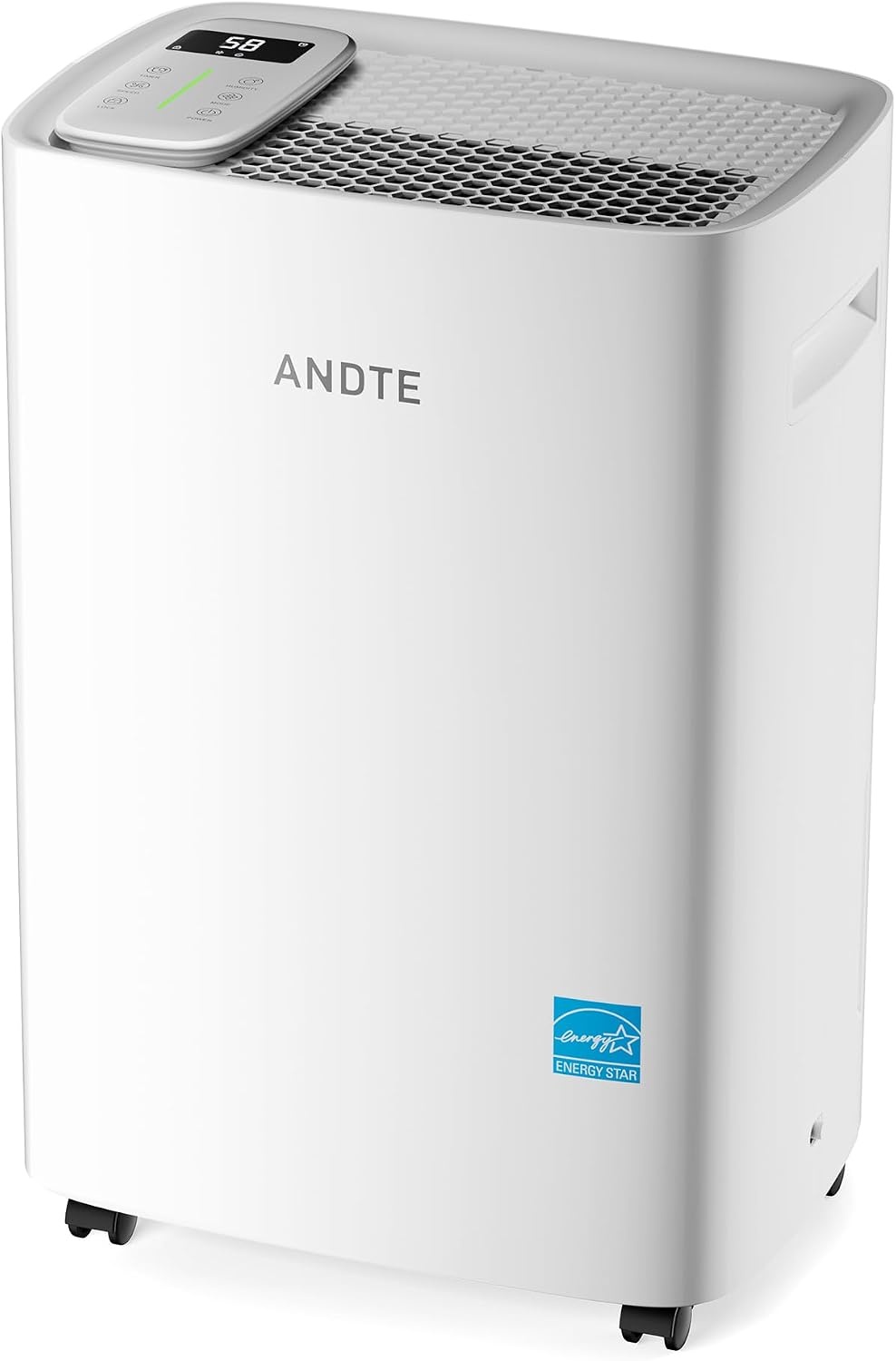
Our pick: 4500 Sq.Ft Energy Star Dehumidifier for Basement with Drain Hose, ANDTE 52 Pints Dehumidifiers for Home Large Room, Bathroom, Intelligent Humidity Control, Touch Control Panel, Auto Defrost
 Visit on Amazon →
This is a 52 pint compressor unit with the thing I care about most already in the box: a drain hose. That detail matters more than any app. In a basement you want to set the hose to a floor drain or a sump and forget the tank exists. Auto defrost is the second feature I look for, because a basement that runs 65 to 70 degrees in summer will still push a coil into frost on a long run, and defrost keeps the machine pulling water instead of freezing itself up.
Intelligent humidity control and the touch panel are conveniences. The humidistat is the part that matters. Set it and then verify it with your own hygrometer, because onboard sensors drift, and a humidistat that is off by 10 points will either run the machine forever or shut it off while the room is still damp.
Flaws but not dealbreakers: This is a compressor machine, so it does not belong in a cold crawlspace or an unheated garage in January. It is also a portable unit with a tank, which means it will shut down if the hose clogs and the tank fills. Check the hose run once a month.
Anyone with a finished basement, a floor drain, and a damp smell that comes back every June should start here.
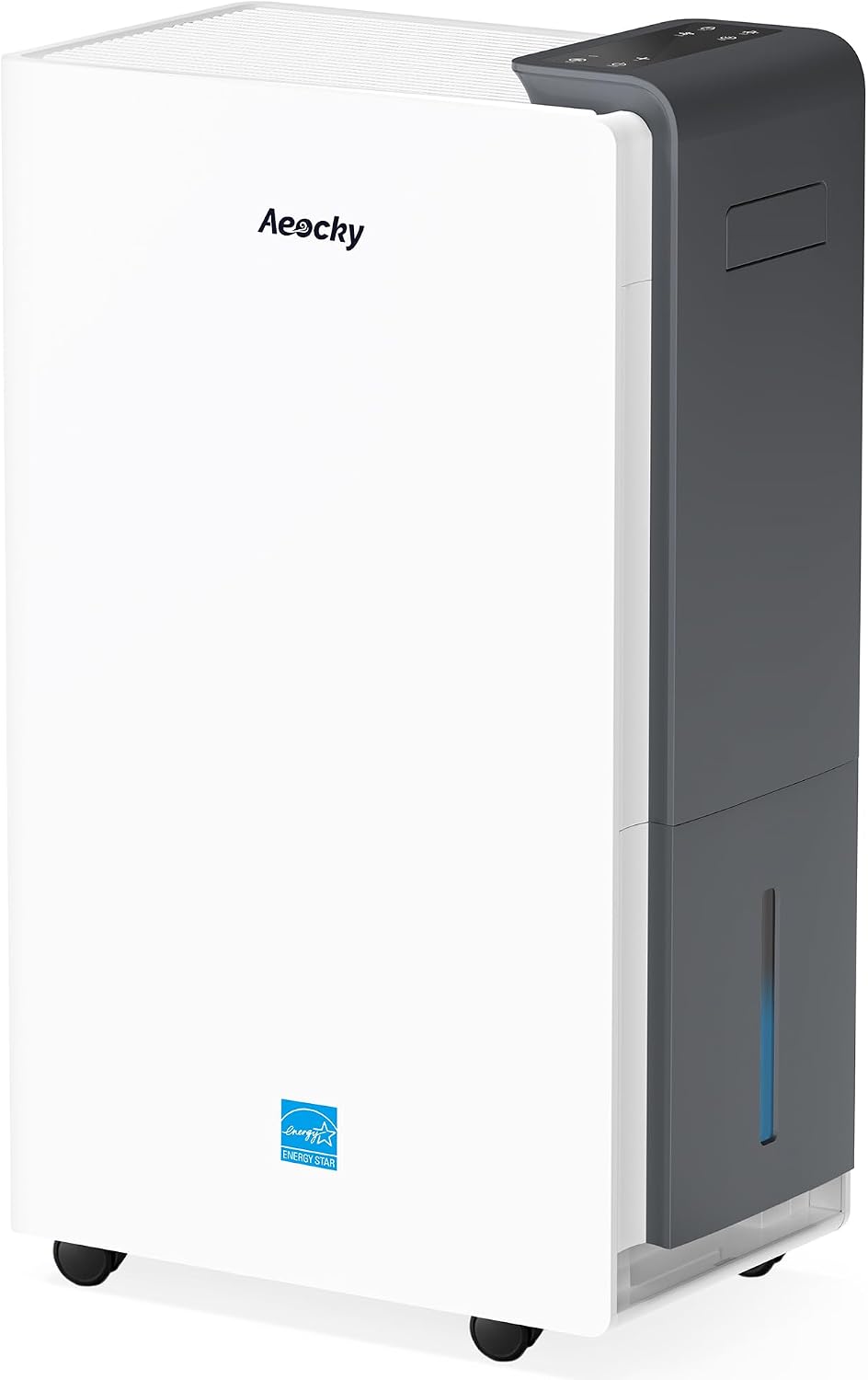
Upgrade pick: AEOCKY 6000Sq.Ft Commercial Dehumidifier, Energy Star Most Efficient 2024
 Visit on Amazon →
Commercial duty is not marketing fluff when the machine runs 12 hours a day for five months straight. This one is rated for 6,000 square feet and carries the Energy Star Most Efficient 2024 label, and that label is the reason I would put it in a rental property or a large open basement where the unit is going to be the biggest single appliance on the circuit. When a machine runs that many hours, efficiency stops being a spec sheet bragging right and turns into a line on the utility bill.
The trade is weight, noise, and cost. A commercial unit is built to move a lot of air, and moving air makes noise. In an open basement that is fine. In a bedroom or a finished den it is a mistake, no matter how well it dehumidifies.
Flaws but not dealbreakers: Overkill for a single damp room. If your problem is one 400 square foot bedroom, this is the wrong purchase and you will be paying for capacity you never use.
Anyone drying a whole open basement, a crawlspace with headroom, or a rental unit they do not want to visit every week should look here first.
Setting it up: the steps that matter
Now the part that decides whether the machine works at all.
Step one: pick the spot before you plug it in. Center the unit in the problem area, not in the corner where the outlet happens to be. Leave 6 to 12 inches of clearance on all sides. Keep it away from the dryer vent, the furnace return, and any place where it will pull the same air it just dried.
Step two: run the hose first. Gravity drain to a floor drain, a sump, or a utility sink, and keep the entire run downhill. A hose with a low loop in it will hold water, and a hose that runs uphill will not drain at all. If you have no drain at floor level, buy a condensate pump instead of emptying a tank every day. I install hose kits as often as I install units, and I have never had a homeowner tell me they missed carrying the bucket.
Step three: set the humidistat to 50%. Not 30, not 35. Below 40% you are paying for kilowatt hours and drying out your woodwork and your sinuses for no benefit. Fifty percent is comfortable, it is hard on mold, and it is achievable. If the basement smells musty, set 45% for a week and then put it back.
Step four: close the envelope. A dehumidifier fighting an open window is a dehumidifier losing. Shut the windows, close the bulkhead, and fix the gap at the bottom of the basement stairs if there is one. If the space is wide open to the rest of the house, you are dehumidifying the whole house, and the sizing math above changes.
Step five: verify with a separate hygrometer. The display on the unit is a sensor, and sensors drift. Put a cheap hygrometer across the room and compare it to the set point after 24 hours. If the room reads 58% while the unit thinks it is holding 50, believe the hygrometer and adjust.
Step six: check what happens after a power outage. Kill the breaker and restore it. Some units come back in fan only, which means the machine is running, the light is on, and no water is coming out. If yours does that, it needs a manual reset every time the grid blinks, and in storm season that is a real problem.
Step seven: clean the filter monthly. A clogged filter is the number one cause of a dehumidifier that "stopped working." Rinse it, let it dry, put it back. If the filter is a proprietary cartridge that costs real money every month, that is a design flaw, not maintenance.
Step eight: expect less in cold weather. Below 65 degrees, a compressor unit spends part of every cycle in defrost. It is not broken. It is doing the only thing it can do with a cold coil.
What I do not put in a basement
Small 20 to 30 pint compressors. They are fine for a closet or a bathroom. In a wet basement they run continuously, never catch up, and die young. If your budget only reaches that class, buy two of them and put one at each end of the space, or fix the water source first.
Units with no hose option. A tank-only machine in a basement means a daily chore, and daily chores get skipped. In August. When the mold is growing.
Desiccant units for a warm, humid basement. Desiccant is the right answer in a cold crawlspace. In a Gulf Coast basement it adds heat to a room you are already trying to keep cool, and it costs more to run.
App-first machines. The Wi-Fi module is the part that fails first and the part that generates the support call. I have reset more wireless modules than compressors, and I have never once needed my phone to dry out a basement.
And sometimes the honest answer is nothing. If your problem is one damp bedroom and you already have a window AC, run it on dry mode for a week and see what the hygrometer says before you spend money on a dehumidifier.
What this all costs
No prices here, because they move. Check current Amazon price on both units above, then add the parts nobody budgets for.
- A drain hose, if it is not in the box. On the ANDTE it is in the box, which is one less thing to buy.
- A condensate pump, if you have no floor drain. This is the difference between a machine that runs itself and a machine you have to babysit.
- Electricity. This is the real cost. Multiply your unit's running watts by the hours it runs, divide by 1,000, and multiply by your utility rate. A dehumidifier that runs 12 hours a day in July is a line item, not a rounding error, and the Energy Star Most Efficient label on the AEOCKY is worth real money when the run hours get that high.
- Filters and coils. Rinse the filter monthly and vacuum the coil once a season.
The machine is the cheap part. The setup is what makes it work: a hose that drains downhill, a humidistat set to 50, a space with the windows shut, and a hygrometer to tell you the truth. Do those four things and a mid-range unit will outperform a bigger machine sitting in a corner with a full tank.
That is the job. Size it for the water, drain it, and let it run.