Most people buy a dehumidifier the way they buy a space heater. They grab whatever is on the shelf during the worst week of the year, plug it in, and hope. Then the tank fills at 2 a.m., the machine shuts off, and by Thursday the baseboard behind the couch smells like a wet dog.
I have been an HVAC tech in New Orleans for 18 years, and I have pulled more moldy drywall out of Louisiana homes than I can count. A damp basement dehumidifier setup is almost never about the box. It comes down to three things: sizing the machine to the actual water load, getting the water out of the machine automatically, and setting the humidistat where it belongs instead of leaving it on continuous.
Get those three right and a mid-priced unit will hold a basement at 45% relative humidity through a Gulf Coast September. Get them wrong and a bigger, more expensive machine will still quit on you in the worst month of the year.
Here is the order I actually do it in.
Why you should trust me
I service and install these units for a living, and I have run more than ten portables through real Gulf Coast summers in my own 1920s shotgun house, which has no central air in the back rooms. That house is my test bed and my punishment.
I keep a hygrometer log for every room, a watt meter on every unit, and a bucket routine where I weigh the water each machine pulls so I know what it actually did, not what the sticker promised. I have reset more Wi-Fi modules than compressors. I have replaced more filters than I want to admit. And I have told plenty of homeowners that the honest answer is to fix the grade outside and skip the machine entirely.
How I judge a dehumidifier before I recommend it
Four things, in this order.
Pints per day, derated. The number on the box is measured in a lab at a friendly temperature and humidity. In a real house, with real door gaps and a real Louisiana August, I cut that number by 30 to 40 percent before I do any math with it.
The tank, or better, the hose. The tank is the product. A unit that shuts off when the tank is full is a unit that stops working at 3 a.m. in the worst month of the year.
Compressor or desiccant, based on temperature. Compressor units win in warm rooms. Desiccant units win in cold basements. Most reviews ignore the temperature split entirely, which is why people in cold climates buy the wrong machine every winter.
Energy, on a meter. I run a watt meter on every unit for a week and do the monthly bill math. The Energy Star label matters more to your wallet than any app feature, and it is the one claim I can check with equipment I own.
Sizing: how many pints per day you actually need
Manufacturer coverage ratings are generous. This is the version I use in the field.
- A single damp bedroom, a closed laundry room, or a small finished basement: a 20 pint class machine.
- A closed basement up to about 1,000 square feet with no obvious water intrusion: 30 to 50 pints.
- An open basement, a crawlspace you are trying to keep from rotting, or a whole floor: 70 pints and up.
- A space that takes on standing water after rain: no portable unit fixes that. Fix the drainage first, then buy a machine to manage the humidity that is left.
Two caveats that save people money. First, the derate. A 20 pint machine in a real Gulf Coast summer is closer to 12 to 14 pints of real work in the worst hours, so do not buy the smallest unit that technically matches your square footage. Second, sometimes the honest answer is two smaller units instead of one big one, because humidity pools in separate rooms and one machine cannot reach around a corner.
The two machines I would put in a real house
Both of these are compressor units, which is what you want in a warm climate. One is sized for a room, the other for a whole floor.
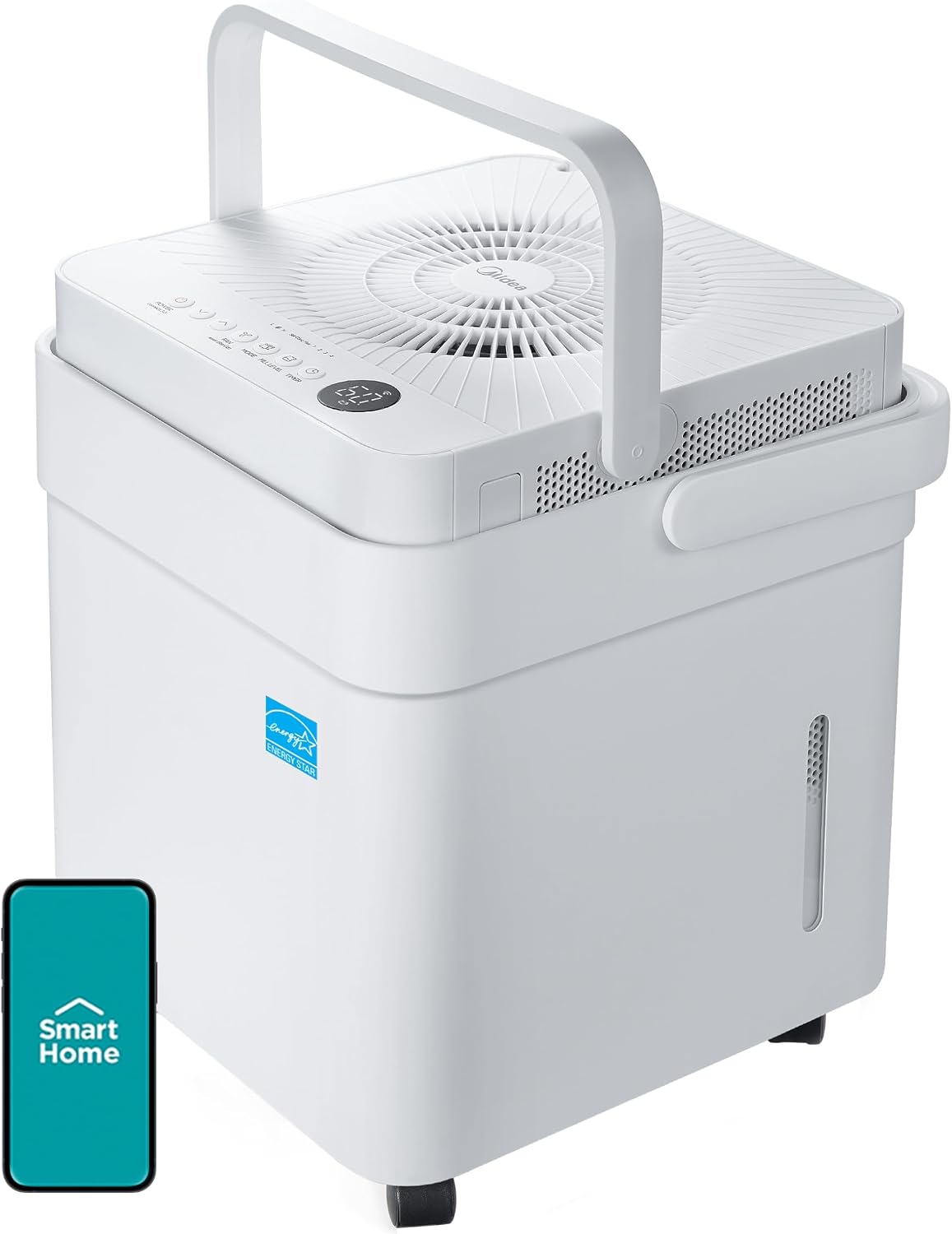
Best for a single room or a small basement: Midea Cube 20 Pint Dehumidifier for Basement, 1,500 Sq. Ft, Energy star
 Visit on Amazon →
This is the class of machine I put in a bedroom, a laundry room, or a small closed basement. It is rated at 20 pints per day and the manufacturer lists coverage up to 1,500 square feet, and it carries Energy Star, which is the label I actually check for monthly cost. Midea is one of the dedicated brands with real compressor supply chain behind it, and that matters more than any feature list when a unit is going to run 12 hours a day for five summers.
Check current Amazon price. What you are buying here is a compact body that fits in a corner and a machine sized for one room. The honest limitation is the pint rating itself. Twenty pints is a lab number at a friendly temperature, and in a real August with a door that does not seal, this unit will spend its afternoon trying to keep up rather than pulling ahead. For a single closed room that is fine. For an open basement with a stairwell, it will run continuously and lose.
Flaws but not dealbreakers: It is a one-room machine. Buy it for one room and plan the hose drain from day one, because the tank on a unit this size is a carry-it-to-the-sink proposition and you will stop doing that by week two.
Anyone with a damp bedroom, a finished corner of a basement, or a laundry room that smells musty will be happy here.
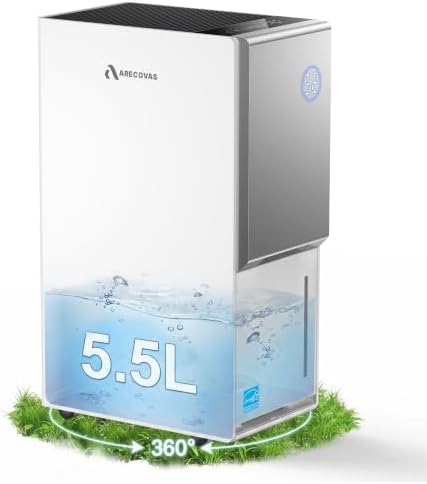
Best for a whole basement or an open floor: Arecovas 80 Pint Dehumidifier Energy Star 2025 Most Efficient, 5000 Sq.Ft
 Visit on Amazon →
Eighty pints per day is whole-floor territory. This is the size I recommend when a homeowner has an open basement with a stairwell, a crawlspace access door that never quite closes, or a first floor that sits over a damp slab. The manufacturer lists coverage up to 5,000 square feet and claims the 2025 Energy Star Most Efficient designation, and if that label holds up on a meter, it is the difference between a machine that costs you real money every month and one that does not.
Check current Amazon price. Two things to know before you buy. First, a unit in this class is heavy and it is loud, and it belongs in the basement, not the hallway outside a bedroom. Second, Arecovas is a newer name in this category than Midea, so buy from a listing with easy returns and put it through a real week before you commit to it. I do that with every new brand and I have never regretted it.
Flaws but not dealbreakers: At 80 pints, this machine will fill a tank fast. If you run it on the tank instead of a hose, you have bought yourself a daily chore. Set it up as a hose-drain unit from the first day and it becomes a background appliance.
Anyone with an open basement, a crawlspace, or a whole floor to dry out should start here rather than buying two small units and hoping.
Tank versus hose drain: the decision that matters most
Tank is fine for a bedroom. Hose is mandatory for a basement or a whole-floor dehumidifier. I install hose kits about as often as I install the units themselves.
Gravity drain is the simplest setup. Run a hose from the unit's drain port to a floor drain, a sump, or out a window well, with a continuous downward slope the entire way. Any dip or low spot in that line holds water, and standing water in a drain hose grows biofilm that eventually clogs it.
Condensate pump is the answer when there is no drain below the machine. It is a small reservoir with a float and a pump that pushes water up and out to a sink, a laundry standpipe, or outside. Every HVAC tech keeps one on the truck, and it turns a basement unit into something you can forget about for a month.
One practical caveat: check the drain port before you buy the hose. Some units take a standard garden hose thread, some take a barbed fitting, and some ship with an adapter that goes missing in the first week. Know which one you have before you are standing in the basement with a hose in your hand.
The setup, step by step
Step one: measure before you buy. Put a hygrometer in the room and log it morning and evening for a week. You want to know the real number, because "it feels damp" is not a spec. If the room sits at 60% or higher, you have a load worth buying for. If it sits at 52%, you may just need better air movement.
Step two: pick the location. Middle of the room if you can, and at least six inches off every wall. A unit pushed against a foundation wall recirculates its own exhaust and works harder for less. Close the doors and windows in the space you are drying, or you are paying to dehumidify the neighborhood.
Step three: run the drain before you run the machine. Hose first, unit second. Slope the line downhill the whole way, secure it so nobody kicks it loose, and confirm the water actually reaches the drain before you walk away.
Step four: set the humidistat to 45 to 50 percent. Not 30. Not continuous. Below 45% you are burning energy to make the room feel cold and dry, and continuous mode is for drying out a space after a leak, not for everyday running. This one setting is where most of your monthly cost lives.
Step five: check the room temperature. Compressor units like this pair are happiest above 65 degrees. In a cold basement below 60 degrees, a compressor can freeze up and cycle badly, and a desiccant unit is the better tool. Do not fight the temperature split, work with it.
Step six: confirm what happens after a power outage. Unplug the unit, wait a minute, plug it back in. If it comes back in fan only instead of resuming dehumidifying, that is a flaw you need to know about before storm season, not during it. This is one of my pet peeves with modern controls, and it is worth testing on day one.
Step seven: clean the filter monthly. Rinse it, let it dry, put it back. A clogged filter on a dehumidifier is like a clogged filter on an air handler: the machine runs, the meter spins, and nothing gets dry. If the replacement filters for your model cost more than you want to pay every month, check whether the original is washable before you buy a stack of them.
Step eight: log the water for the first week. Weigh the bucket or count how often it fills. If a unit rated at 80 pints fills a tank twice a day in your space, it is working. If it runs all week and pulls almost nothing, your problem is air leakage or a water source, not the machine.
Mistakes I see in almost every house
- Trusting the humidistat on the unit. I have met very few that agree with a good hygrometer. Check yours against a separate meter, and if it is off by 15%, set the dial to compensate instead of arguing with it.
- Running on the tank in a basement. The machine shuts off when the tank fills, and it fills overnight. You wake up to a room that has been soaking for six hours.
- Buying for square footage instead of water load. A 1,500 square foot basement with a wet slab and a leaky bulkhead is not the same job as 1,500 square feet of dry finished space.
- Placing it against a wall or inside a closet. Both kill airflow and both make the unit look broken when it is just starved.
- Expecting the machine to fix a leak. A dehumidifier manages humidity. It does not manage water coming through a wall.
What this costs
The purchase is the easy number to look at, and it is also the least important one. Check current Amazon price on the units above and compare that against what the machine will cost you to run for five summers, because that is where the money actually goes.
Do the math this way. Find the unit's wattage, multiply by the hours it will realistically run in a day (start with 12 in a Gulf Coast summer, 6 in a drier climate), divide by 1,000 to get kilowatt hours, then multiply by your local rate. A machine that runs efficiently and gets the room to setpoint fast will beat a bigger machine that never catches up, every single time.
Then add the accessories, because they are not optional in a basement: a drain hose, and a condensate pump if you have no drain below the unit. Together they usually cost less than the machine, and they are the difference between a dehumidifier you own and a dehumidifier that actually works.
If you want to verify your own results, a plug-in watt meter and a cheap hygrometer together cost about what one tank of gas does, and they will tell you more about your setup than any product page.
The short version
Size the machine to the real water load, not the square footage on the box. Cut the pint rating by a third in your head before you decide. Run a hose drain, because a tank is a timer that turns your dehumidifier off in the middle of the night. Set the humidistat to 45 to 50 percent and leave it there. Then check it once a week with a hygrometer and clean the filter every month.
That is the whole job. The machine is the easy part. The setup is what keeps a basement dry.