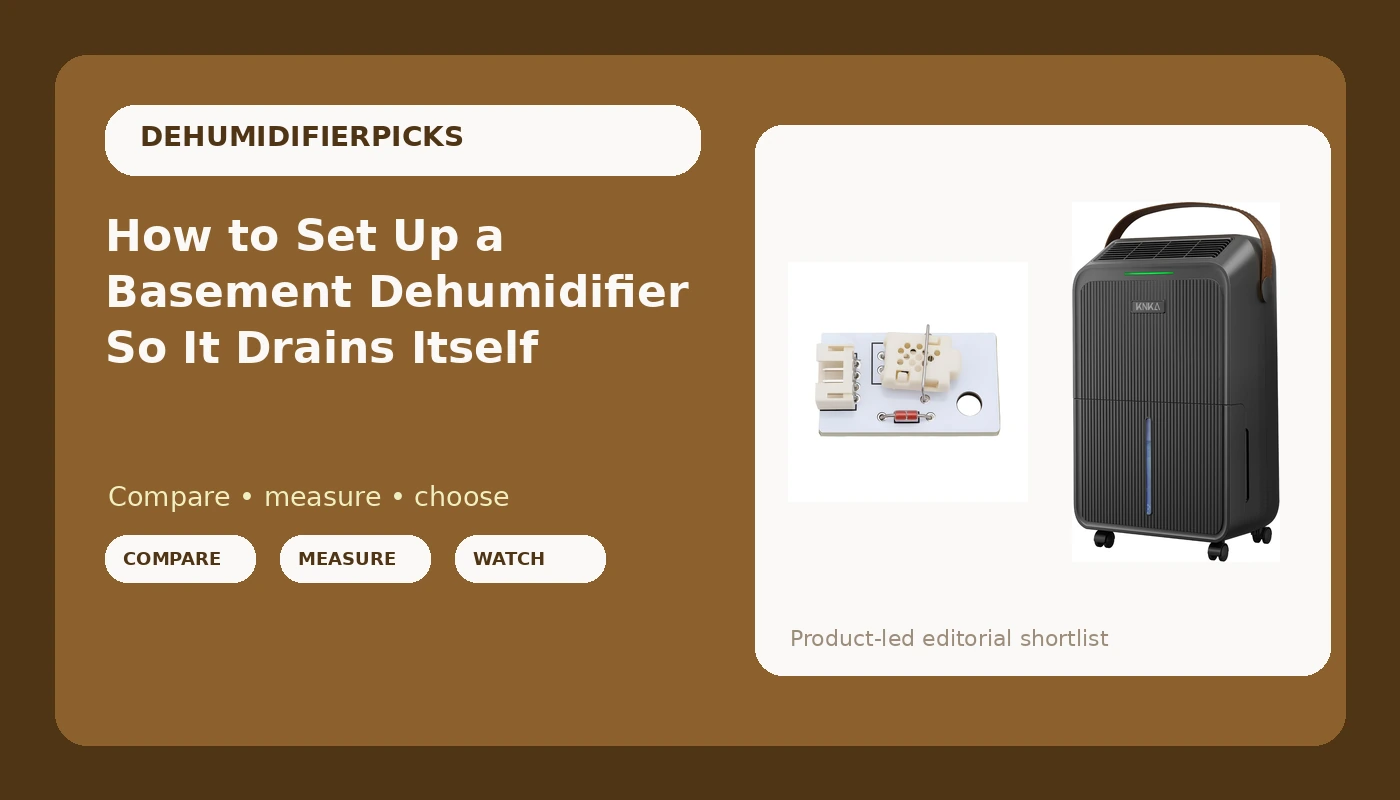
Most dehumidifiers in Louisiana do not die of old age. They die of a full tank. The homeowner buys the right machine, sets it in the corner, plugs it in, and then spends the next three months emptying a bucket twice a day. By August the unit is short cycling in the worst humidity of the year, the basement smells like wet carpet, and the machine that was supposed to fix the problem is the thing that quit at 3 a.m.
A proper dehumidifier hose drain setup fixes most of that in about twenty minutes, with a drill, a clamp, and a length of tubing.
I am Carlos. I have been an HVAC technician in New Orleans for eighteen years, and I have pulled more moldy drywall out of Gulf Coast homes than I care to count. I run portable dehumidifiers in my own 1920s shotgun house, where the back rooms have no central air and the door gaps are wide enough to pass a paperback through. I keep a hygrometer log, a watt meter, and a kitchen scale for weighing the water each unit pulls.
Why you should trust me
Eighteen years of installs and service calls along the Gulf Coast means I have seen what happens to a basement when the humidity never gets below 65 percent. I have run more than ten portable units through real summers in my own house, not in a climate chamber. I weigh the water instead of trusting the readout, I run a plug-in watt meter for a week on every machine that comes through my door, and I log the hygrometer twice a day during the wet months.
That routine is the reason I care less about the marketing on the box and more about four questions: does the unit have a gravity drain port, does it restart into dehumidify mode after a power cut, does the humidistat agree with my reference hygrometer, and can I live with the tank if the hose ever clogs.
How I picked and how I tested
Two pieces of gear matter for this job. The machine, and a way to verify the machine.
I will be straight with you: I have not had the exact units below on my bench for a full month. What I can tell you is how the specs translate into a real house, and what to check the day the box lands on your porch. Everything here is either a number you can verify yourself or a step from my own install routine, and the verification steps are the part most people skip.
For a basement machine, the checklist I run is short. Confirm the drain port is gravity fed, not pump assisted, because gravity never loses power. Confirm the unit runs with the tank removed, because the tank interlock is the first thing to annoy you. Confirm the compressor is a compressor and not a Peltier plate pretending to be one. Then put a hygrometer ten feet away and see whether the onboard humidistat tells the truth.
The two things to buy before you start
You need the machine, and you need a way to check its brain. The drain hardware is a hardware store trip, not a purchase decision.
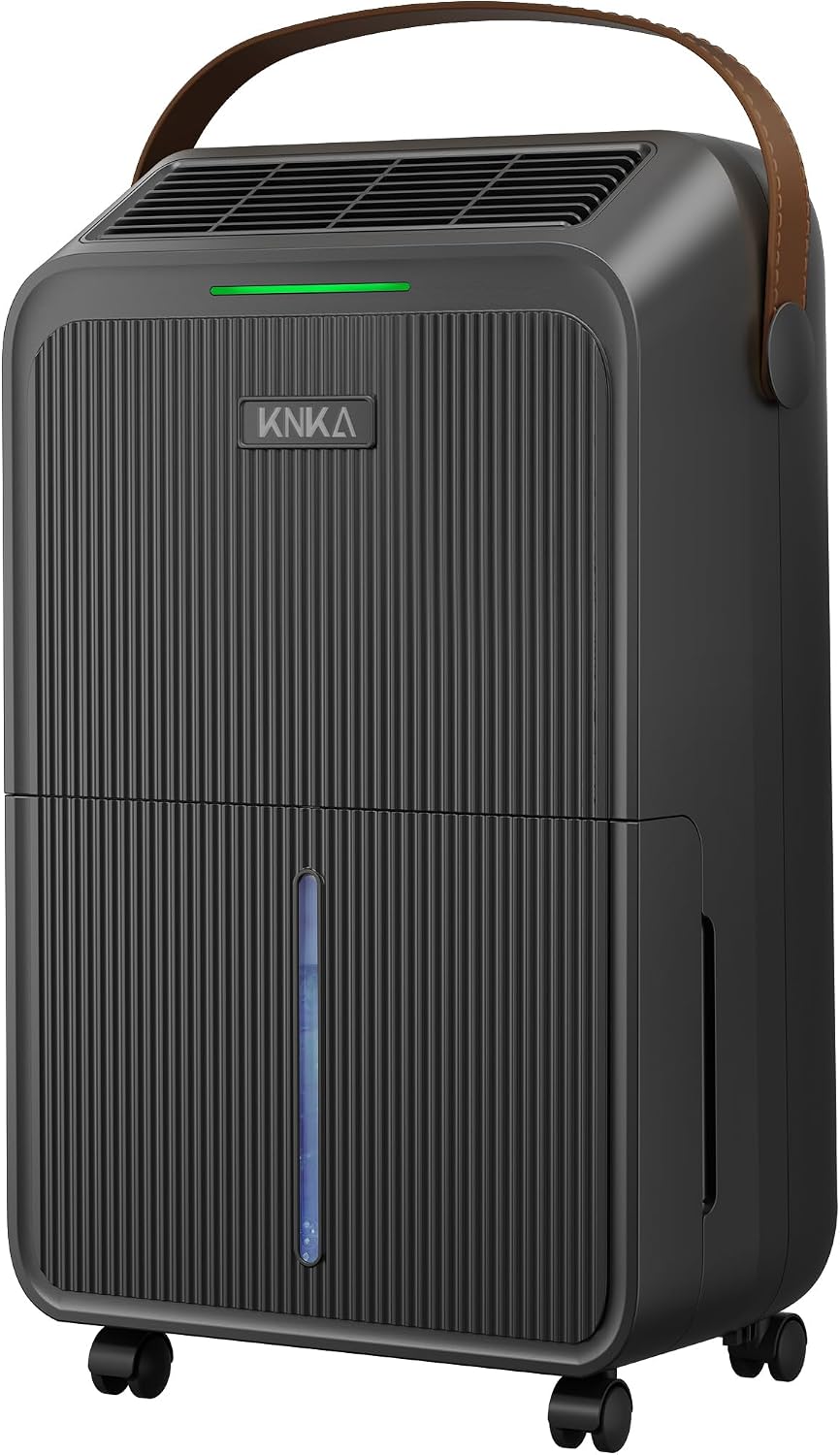
Our pick: KNKA 2500 Ft² Max 34 Pints Dehumidifier for Basement with Drain Hose, Black
 Visit on Amazon →
The reason this one is on the list is the drain hose in the box and the basement footprint. A machine that ships with a hose means the manufacturer expects you to use it, and that is the right expectation for a basement. It is a compressor unit, which is the correct technology for warm, wet air, and it has a tank as a fallback for the shoulder seasons when you are not running it hard.
Now the honest part. Thirty-four pints is a lab number, measured under friendly conditions. In a real Gulf Coast basement, with a door gap, a concrete slab, and an 84 percent afternoon, cut that rating by 30 to 40 percent. That puts you in the low twenties of actual water per day. That is still honest coverage for a damp 800 to 1,200 square foot basement, or the whole first floor of a shotgun house if you keep the interior doors open. The 2,500 square foot maximum on the box is a ceiling, not a promise, and it assumes a sealed space at moderate humidity.
What to check when it arrives: where the drain port sits relative to the tank, whether the supplied hose reaches your floor drain, and whether the unit keeps running with the tank pulled out. It should. You are going to run it that way for four months.
Flaws but not dealbreakers: The hose that comes in the box is usually shorter than the run you actually need, so plan on a hardware store trip for an extension, a clamp, and zip ties. Compressor units are also heavier than they look, and this class of machine is not something you carry up a staircase alone.
Anyone with a damp basement, a crawlspace access, or a first floor that never dries out will get real work out of this machine.
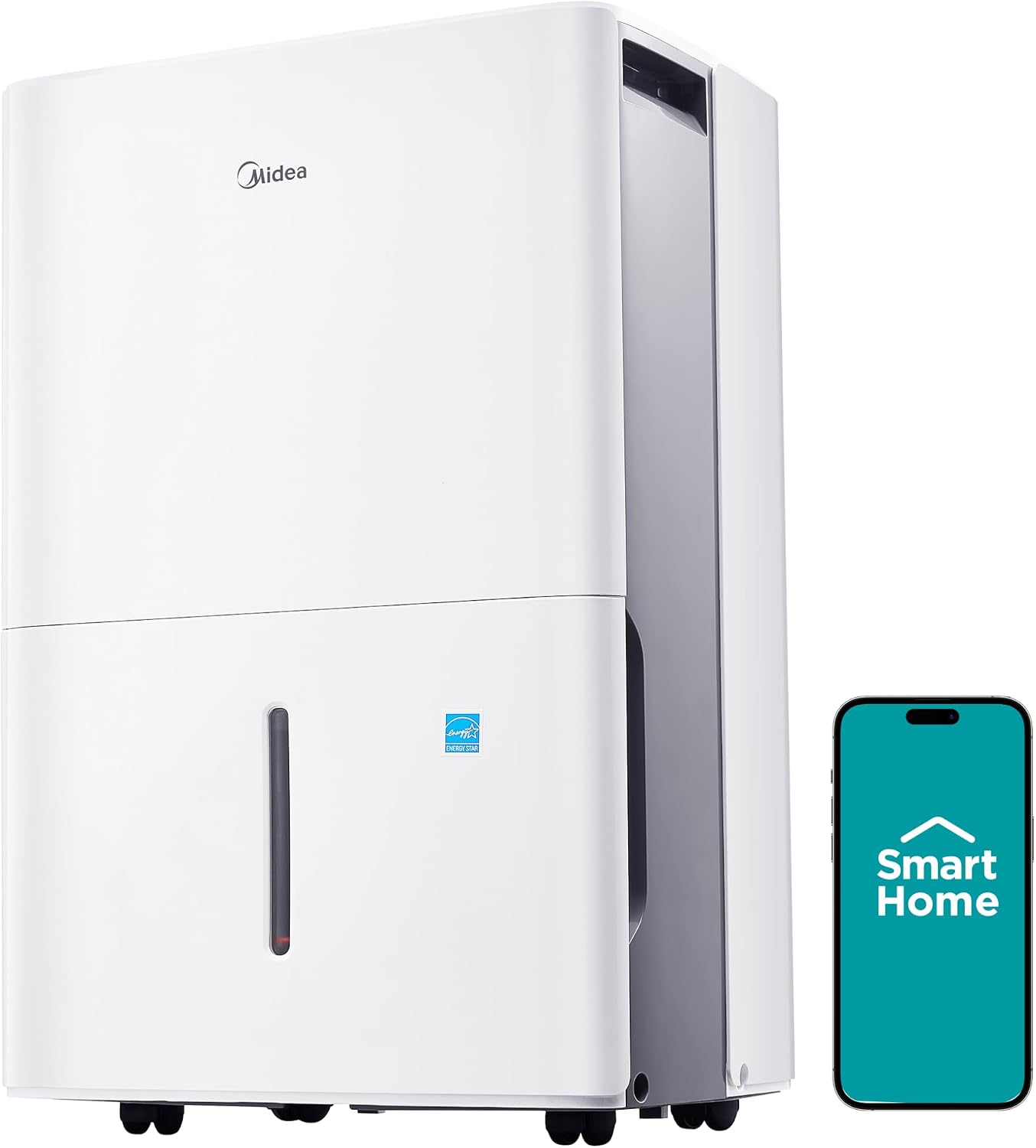
Also worth having: Create idea Humidity Sensor Compatible with Honeywell TP30WKN TP50WKN TP70WKN Dehumidifier Replacement Parts
 Visit on Amazon →
The onboard humidistat is the weakest part of any consumer dehumidifier, and it is the reason so many people think their machine stopped working when it is actually just lying about the room. A sensor that drifts five or ten points will leave you running a compressor for hours after the space is dry, or shutting off while the basement is still clammy.
If you own a Honeywell TP30WKN, TP50WKN, or TP70WKN and the readout disagrees with your hygrometer, the sensor is the usual suspect, and this is the replacement part for those three models. Match the model number on your unit's data plate before you order, because these parts are model specific and a return costs you a week of drying.
Flaws but not dealbreakers: It is a replacement part, not an upgrade, so it will not turn a cheap machine into a precise one. It restores the original behavior. Keep the connector clean when you install it and do not bend the pins.
Anyone running one of those Honeywell units who has watched the humidity readout drift away from reality should keep one of these on the shelf. Sensors fail in the middle of the wet season, not in February.
The actual hose drain setup
Now the part you came for. This works on any basement dehumidifier with a gravity drain port, and it takes one afternoon the first time.
Step one: pick the drain destination. A floor drain, a sump pit, a utility sink, or a condensate pump. Never dump a hose into a sewer line without a trap and an air gap, because you are one dry trap away from pulling sewer gas into the room you are trying to dry out. If your only option is a sink above the unit, stop and buy a condensate pump.
Step two: confirm gravity. Every inch of the run has to fall from the drain port to the destination. If you cannot get fall, a pump is the answer. A hose that runs uphill, or sags into a low spot between two zip ties, will hold water, grow slime, and eventually back up into the tray.
Step three: kill the power and pull the tank. Find the drain port. On most basement units it is a cap or plug at the back, above the tank opening. Remove the cap and keep it in a zip bag taped to the side of the cabinet, because you will want it if you ever move the machine into a bedroom.
Step four: run the hose. Keep it short, keep it falling, and watch the bend where it leaves the cabinet for kinks. A hose clamp at the port and zip ties every couple of feet will hold it. Do not strap the hose tight against a hot discharge line or a furnace flue.
Step five: test with a pitcher. Pour a quart of water into the drain pan and watch it leave. If it does not leave, fix the slope before you plug the unit back in. This two minute test saves a flooded floor.
Step six: set the humidistat. In a basement in summer, 50 to 55 percent relative humidity. If you can smell mustiness, 45. Do not chase 30 percent. You will run the compressor into the ground and the space will still feel clammy, because cold surfaces sweat at any humidity when the air is cool enough.
Step seven: verify with a separate hygrometer. Put it ten feet away and three feet off the floor. Compare it to the unit's readout after four hours of running. If the two disagree by more than five points, trust the hygrometer, adjust your setpoint around the offset, or replace the sensor.
Step eight: log it for a week. Write down the hygrometer reading and how long the compressor runs. After seven days you will know whether the machine is sized right. If it never shuts off and the humidity will not come down, you do not have a setup problem, you have a sizing problem.
Sizing, because pints per day is a lab number
Pints per day gets measured under friendly conditions, typically around 80 degrees and 60 percent relative humidity. Your basement in July is not that. A cool slab at 68 degrees and 85 percent humidity changes the math, and so does every door gap and every load of laundry drying on a line down there.
Cut the box rating by 30 to 40 percent for real world conditions. A 34 pint machine is realistically a 20 to 24 pint machine in a wet Gulf summer, and that is fine for the space it is built for. It is not fine for 2,000 square feet of open basement.
Temperature matters just as much. Compressor units lose capacity as the air cools, and below roughly 60 degrees they start icing and cycling. If your space stays cold year round, a desiccant unit is the right tool and no compressor will change that. Match the technology to the room temperature, not to the square footage on the label.
The 3 a.m. problem
The tank is the product. A unit that shuts off when the tank fills is a unit that stops working at 3 a.m. in the worst month of the year, and the room it was protecting starts growing mold again by breakfast. A hose drain ends that permanently, which is why I treat it as part of the machine and not an accessory.
Two other habits matter. First, check the unit after every storm, because some machines come back in fan only mode after an outage and will happily blow wet air around a damp room all night. Second, clean the filter every two weeks in the wet season. A clogged filter drops airflow across the coil, the coil ices, and you blame the machine for a maintenance problem.
The competition and why it lost
Desiccant units are the right answer for cold basements and garages that sit below 60 degrees, and they cost more to run in warm air. Compressor units like the one above win in a Gulf Coast summer and lose in an unheated Michigan cellar.
A window air conditioner with a dry mode is genuinely enough for one small sealed room, and I tell people that when it is true. It is not enough for a basement, because the AC has to reject heat somewhere and the space is usually already cool.
Whole house sizing is a different conversation. That is an install with a load calculation, not a setup guide, and if your basement needs two machines, you need two machines. Nobody wants to hear it.
What it all costs to run
Use a plug-in watt meter for a week. Compressor units cycle, so the number you want is kilowatt hours over seven days, not the amps printed on a sticker. Multiply those kilowatt hours by your own utility rate and you have a monthly figure you can defend, which is more than the box can tell you.
Then compare. An inverter compressor unit that runs longer at a lower draw can beat a fixed speed machine that slams on and off, and the efficiency gap is real and measurable. But you have to measure it in your house, with your humidity, not on a spec sheet. A machine that runs twelve hours a day at a low draw costs less to own than one that runs around the clock, and the only way to know which one you own is the meter.
The bottom line
Buy a machine with a gravity drain port, run the hose downhill, set the humidistat at 50 to 55, verify the readout against a hygrometer you trust, and check it after every storm. That is the whole job, and it is the difference between a dehumidifier that protects your basement and a bucket you empty twice a day until you give up and return it.