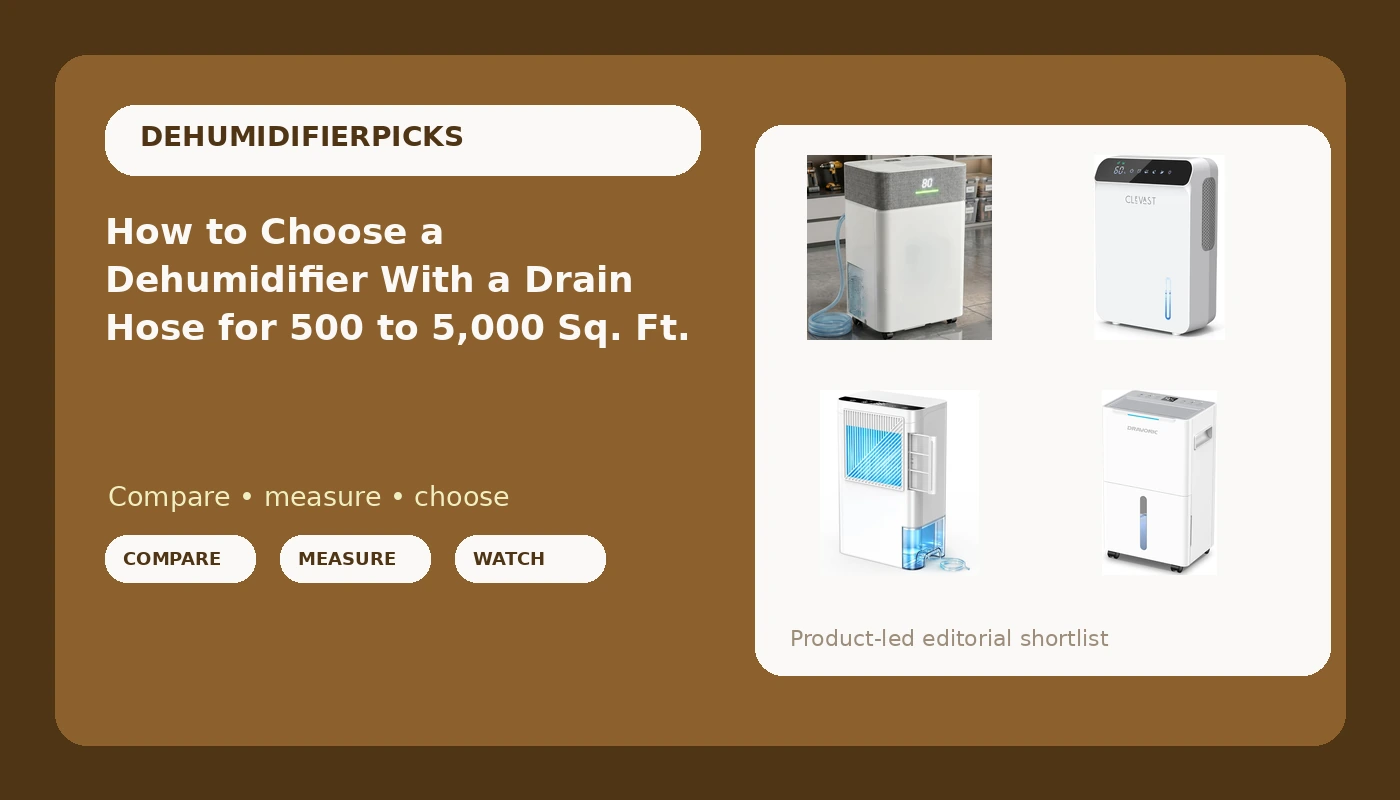
A dehumidifier with a drain hose is the difference between a machine that runs all summer and a machine that shuts itself off the moment you stop paying attention. Tanks fill. In a damp basement in July, they fill faster than most people expect, and a unit that quits at 2 a.m. lets the room climb back toward the range where musty odors and mold take hold. All four machines below include a hose option, and they span a wide spread of rooms, from a 500 sq ft bathroom unit to a machine that claims 5,000 sq ft of basement coverage. The useful question is not which one wins in general, because there is no general answer. It is which one matches your room, your drain situation, and your willingness to empty a tank.
Related: Compressor vs Desiccant Dehumidifiers: Which One Fits Your Basement? →
Quick answer
Size the unit to the room first, then confirm you have a drain path. If you can run a hose to a floor drain, a sump, or a sink, buy for coverage and treat tank size as a backup detail. If you cannot, tank capacity and auto shut off matter more than any other feature. For a small bedroom or bathroom, the 500 sq ft unit is the sensible starting point. For a mid-size room, the 1,500 sq ft and 2,000 sq ft units add capacity, and the 2,000 sq ft unit pairs its hose with a 2.5L tank for backup. For a large open basement, the Uthfy unit is the only one here that lists coverage in the 5,000 sq ft range, and it also carries the longest feature list: reusable filter, dual-screen, child lock, intelligent humidistat, and a 24-hour timer.
Four useful options
| Model | Best fit | What stands out |
|---|---|---|
| Uthfy 5000Sq.Ft Dehumidifier for Basement with Drain Hose, Large Quiet Smart Compressor Dehumidifiers for Home/Bedroom/Bathroom, Reusable Filter, Dual-Screen, Child Lock, Intelligent Humidistat, 24H Timer | Large basements and open floors | Largest coverage claim in the group, with a drain hose, reusable filter, dual-screen, child lock, humidistat, and 24-hour timer |
| Dehumidifiers for Home, 2000 Sq.Ft New Rotary Dehumidifier with Drain Hose/2.5L Water Tank, Quiet Dehumidifier for Basement Bedroom Bathroom RV, Auto Shut Off, Sleep Mode, 7-Color Ambient Light | Mid-size rooms where a tank is wanted | Hose and a 2.5L tank together, plus sleep mode, auto shut off, and a 7-color ambient light |
| 21 Pint Dehumidifier for Basement, Home & Bedroom, 1,500 Sq. Ft. | Bedrooms and mid-size rooms | A stated 21 pint rating and 1,500 sq ft coverage, listed for basement, home, and bedroom use |
| Dehumidifier for Bedroom, Bathroom, with Drain Hose, Quiet, Up to 500 Sq.ft | Small bedrooms and bathrooms | Compact coverage claim with a drain hose included, described as quiet |
For large basements and open floors: Uthfy 5000Sq.Ft Dehumidifier for Basement with Drain Hose
Coverage claims at this end of the market deserve a hard look before you buy. A 5,000 sq ft figure assumes a closed space at a moderate temperature with a starting humidity that most basements blow past. Treat the number as a ceiling, not a promise, and expect the real working area to be smaller once you account for an open stairwell, a leaky bulkhead door, or a concrete floor that stays cool year round. That said, a machine in this class is the right shape of product for an unfinished basement that you want to hold near 50% relative humidity without babysitting it. Pair it with a gravity drain and it becomes a set-and-forget appliance for the wettest months. Put it in a 200 sq ft bedroom instead and it will short-cycle, cooling the space and shutting down before it does much drying.
For mid-size rooms with tank backup: Dehumidifiers for Home, 2000 Sq.Ft New Rotary Dehumidifier
The dual drain setup is the most useful thing about this machine, and it is worth being clear about why. A 2.5L tank sounds generous until you do the arithmetic: in a genuinely damp room, a compressor dehumidifier can pull several liters a day, which means the tank may need emptying more than once daily at peak. That is fine for a bedroom where you are home every evening. It is not fine for a basement in a wet month. The hose solves that, and the auto shut off is the safety net for the days you forget. Sleep mode matters more than most shoppers expect, because a compressor cycling on and off at night is the complaint that drives people to return these units. The ambient light is a preference feature, not a performance one, so weigh it accordingly.
For bedrooms and mid-size rooms: 21 Pint Dehumidifier for Basement, Home & Bedroom, 1,500 Sq. Ft.
Pint ratings are the most misread spec in this category, and this unit is a good place to make the point. A pint figure is measured at a specific temperature and humidity, typically a warm room at around 60% relative humidity, and it describes the maximum the machine can remove in a day under those conditions. In a cool basement at 60 degrees, the same machine will pull less, sometimes far less, because a compressor coil loses efficiency as the air around it cools. So a 21 pint machine is a reasonable fit for a bedroom, a small finished basement, or a laundry room. It is not a substitute for a large-capacity unit in an open, unfinished space, no matter what the coverage number suggests. The upside of buying on a pint rating is that you can compare across brands without decoding anyone's slogan.
For small bedrooms and bathrooms: Dehumidifier for Bedroom, Bathroom, with Drain Hose
Small units get dismissed too quickly. A bathroom that stays damp after showers, or a bedroom over a crawlspace, is a 100 to 200 sq ft problem, and a compact machine running on a hose can hold that room at a comfortable humidity for very little energy. The listing here is thin on detail compared with the larger units, so read the current product page carefully for tank size, humidistat controls, and whether the hose is a gravity drain or needs a pump. The tradeoff is straightforward: you give up capacity and features, and in return you get a machine that fits on a counter or in a corner, runs quietly enough for a bedroom, and drains itself if you route the hose correctly.
Prices and availability may change. Product images, names, and retailer links are matched to verified listings. No current price, rating, stock status, or measured result is stated here without current evidence.
What coverage and pint ratings actually mean
Two numbers drive most dehumidifier purchases, and both are measured under conditions your house does not reproduce. Coverage in square feet assumes a closed room, a standard ceiling height, a warm temperature, and a moderate starting humidity. Pint ratings assume something similar. Under the current federal test standard, capacity is measured in a warm, humid chamber, and the resulting number is the maximum daily moisture removal under those specific conditions.
That matters when you compare a unit labeled under the older test standard with one labeled under the newer one. A machine that was sold as a large-capacity unit years ago may carry a noticeably lower pint number today even though the hardware is similar, because the test conditions changed. When you see two listings with pint ratings, check that you are reading the same standard before you conclude that one is stronger. The same caution applies to square footage. A 1,500 sq ft claim and a 2,000 sq ft claim can describe machines that behave almost identically in a real room.
The practical translation: cut the coverage figure substantially for a cold, leaky, or open space, and treat the pint number as a maximum rather than a daily average.
Compressor versus desiccant, and why room temperature decides
There are two families of dehumidifier, and the split is about temperature, not price. Compressor units work like a refrigerator: a cold coil condenses moisture out of the air. They are efficient in warm conditions and lose ground as the air cools, because the coil drops below the dew point less readily and the unit spends time in defrost cycles instead of drying.
Desiccant units pass air over a moisture-absorbing wheel and regenerate it with heat. They hold up better in cool spaces, which is why they show up in cold-climate basements, but they add warmth to the room and generally cost more to run per pint removed.
In this group, the Uthfy listing names a compressor design and the 2,000 sq ft listing names a rotary design, which points to compressor-family machines. The other two listings do not state the technology, so treat that as an open question and check the product page. If your basement sits in the low 60s or below for much of the year, the compressor-versus-desiccant question deserves an answer before you buy anything.
A five-step way to pick
- Measure the room, including ceiling height, and note whether it is closed off or open to a stairwell or hallway.
- Log the temperature and humidity for a week with a hygrometer. If the space stays below about 65 degrees, reconsider whether a compressor unit is the right family.
- Find your drain. A floor drain, sump, or utility sink within hose reach is ideal. If the hose has to run uphill, plan on a condensate pump.
- Decide between hose and tank based on how often you are actually in that room, then check tank size and auto shut off if you will rely on the tank.
- Compare controls last: humidistat, timer, filter type, child lock, and how the unit behaves after a power outage.
Practical guidance for the first month
- Keep a standalone hygrometer in the room and set the humidistat to match it. Built-in humidistats are frequently off by several points.
- Target 45 to 50 percent relative humidity. Lower is not automatically better, and it costs more to maintain.
- Give the unit 12 to 18 inches of clearance on all sides. Restricted airflow is the most common reason a dehumidifier underperforms.
- Run the hose with a continuous downward slope. Any low spot or uphill section traps water and eventually floods the unit or stops the drain.
- Clean the filter every couple of weeks during heavy season. A reusable filter saves money only if you actually rinse it.
Which option should you choose?
Choose the Uthfy 5000Sq.Ft Dehumidifier for Basement with Drain Hose when you are drying a large, open basement and can run a hose to a drain. Choose the Dehumidifiers for Home, 2000 Sq.Ft New Rotary Dehumidifier when the room is mid-size and you want both a hose for long runs and a 2.5L tank for the days you cannot reach a drain. Choose the 21 Pint Dehumidifier for Basement, Home & Bedroom, 1,500 Sq. Ft. when you want a stated pint rating to compare against other brands in a bedroom or a small finished basement. Choose the Dehumidifier for Bedroom, Bathroom, with Drain Hose, Up to 500 Sq.ft when the problem is one small, closed room and a compact, quiet machine is the right size.
One caveat applies to all four: coverage figures and pint ratings come from the listings and from standard test conditions, not from your house. Nothing here replaces checking the current product page for the tank size, hose type, and control set before you order.
The bottom line
Match the machine to the room, then solve the drain. A hose turns any of these units into something that works while you sleep, and that is the single biggest difference between a dehumidifier that helps and one that sits in a corner switched off. Start with your room size and temperature, pick the coverage class that fits, and let tank size and smart features break the tie.