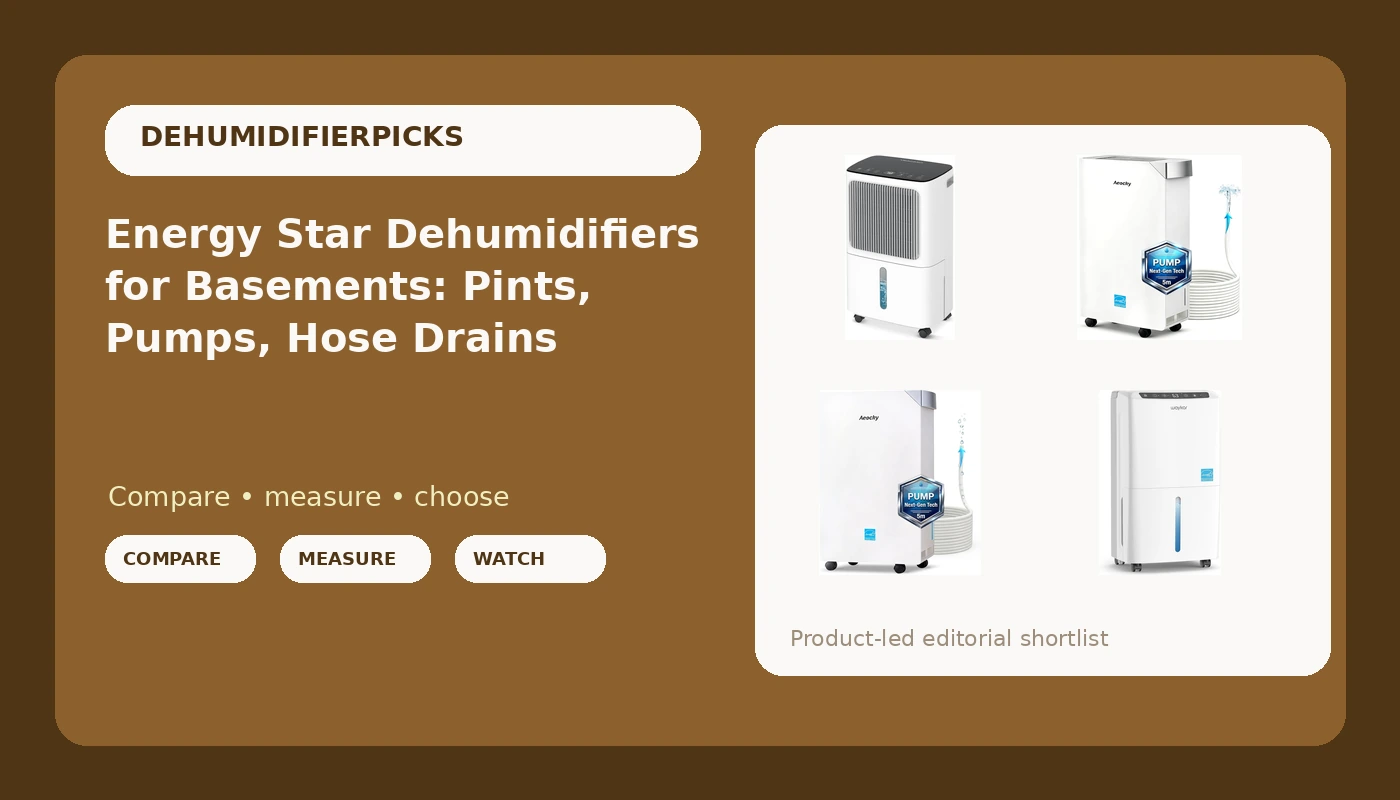
Related: Best Dehumidifier for a Basement That Drains Itself
I have pulled moldy drywall out of more Louisiana homes than I care to count, and the story is almost always the same. A back room or a basement sits above 60 percent relative humidity from May through October, and somebody bought whatever dehumidifier was cheapest at the end of the aisle. If you are shopping for an Energy Star dehumidifier for basement duty, the box is the least honest document in the room.
Here is what I tell people when they sit in the buyer's chair. Pints per day is a lab number, measured at a temperature and a humidity that nobody actually lives in. Cut the rating by 30 to 40 percent for a real house with door gaps, a leaky sill, and an open stairwell, then size from that number instead. The tank is the product. A unit that shuts off when the tank fills is a unit that quits at 3 a.m. in the worst month of the year, which is exactly when you needed it running. And a hose drain stops being optional below 60 percent conditions. I install hose kits about as often as I install the machines themselves.
The four units below are what I would put in front of a Gulf Coast homeowner right now. Two are pump units from AEOCKY, one is a 34 pint hose-drain machine from VEAGASO, and one is a Waykar with a tank plus the option to drain by hose. Same basic job, four different answers depending on where the water is going to go.
What I check before I recommend anything
Four things, in this order.
Drainage first, always. Gravity hose, internal pump, or tank only. A gravity hose needs a floor drain or a low window, and it needs a continuous downward slope the whole way or the condensate sits in the line and grows its own science project. A pump lifts condensate up and out, which is what you want in a finished basement where the only exit is a utility sink or a window above the machine. A tank is fine in a bedroom and a mistake in a basement, because somebody has to carry it, and nobody wants to carry it twice a day in July.
Second, the efficiency listing. Energy Star Most Efficient is a real list with a year attached, and the year matters because the bar moves upward. The 2025 bar is tighter than the 2024 bar. If a listing says Most Efficient, find out which year it earned, because a 2024 model still sitting in a warehouse is not the same claim as a 2025 one. That single line tells you more about what you will pay per month than any other spec on the page.
Third, the humidistat. I keep a hygrometer in the room and compare it against the set point. A humidistat that reads 10 or 15 percent off will run the compressor longer than the room needs, and you pay for that error every month on the bill. Set it to 50 percent, then verify with your own meter, not the display on the machine. If the two disagree, trust the meter.
Fourth, what happens after a power outage. Plenty of units restart in fan only. The fan spins, the room feels like something is happening, and the compressor never comes back on, so humidity quietly climbs back to 65 percent while you are at work. I ask about restart behavior before I sell anybody anything, and I have reset more Wi-Fi modules than compressors. The app is a support call generator. The hose is the feature.
The hose-drain workhorse: VEAGASO 34 Pint
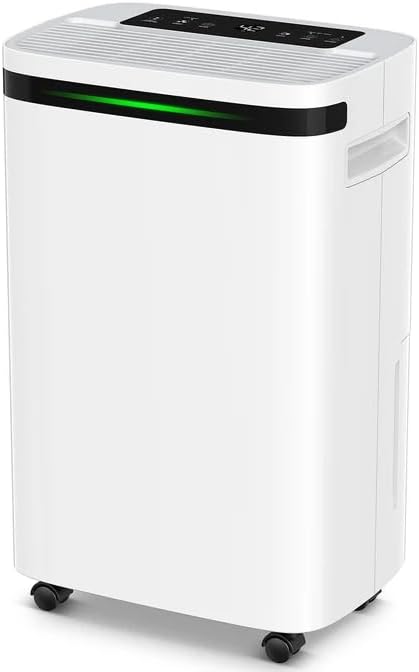
The VEAGASO 34 Pint/D unit is rated for spaces up to 2,500 square feet and it comes with a drain hose in the box, which is the most important accessory in this entire category. If your basement has a floor drain, a sump pit, or a cleanout you can reach, this is the simplest way to get continuous drainage without paying for a pump you do not need.
This is the unit I would point at a bare concrete basement or a storage room, the kind of space where you are not chasing 45 percent, you are trying to keep the joists and the cardboard boxes from sweating. Run the hose to the drain, set the humidistat to 50, and leave it alone for the season. No bucket, no daily chore, no 3 a.m. shutdown.
The 2,500 square foot figure is a coverage claim under ideal conditions, not a promise. In a real house with an open stairwell and a door at the top of the steps, plan on it covering less than that. If the space is genuinely large, or you are fighting a wet wall that weeps after every storm, you are probably looking at two units, and I would rather tell you that now than have you find out in August. Sizing up is not a failure. Oversizing one machine and running it flat out for four months is.
The pump units: AEOCKY with Pump
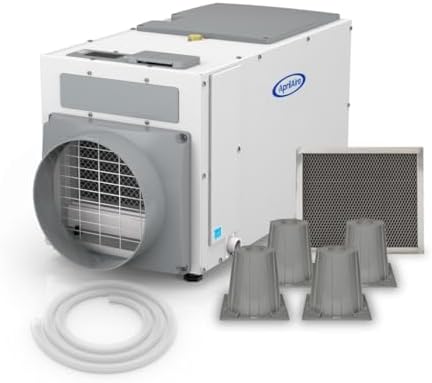
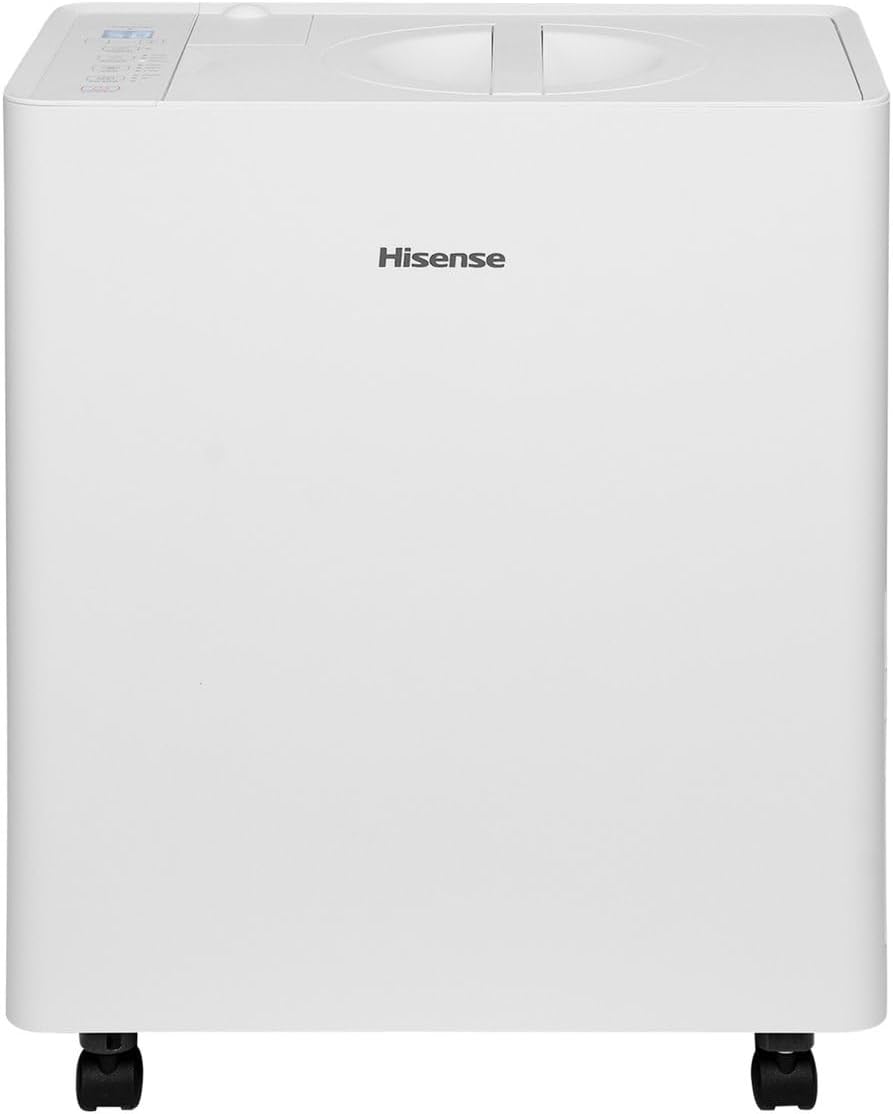
Two separate machines here, and the only difference that matters on paper is the year on the efficiency listing. Both are AEOCKY units with a pump that lifts condensate up to 16.5 feet. One carries the Energy Star Most Efficient 2024 designation, the other carries 2025.
The 2024 version is the one to look at if it is the better deal on the day you buy. It is a pump unit with a Most Efficient rating, and a rating that was good enough to earn a place on that list does not stop working when the calendar turns. What it will not have is the tighter bar of the following year, so if the two AEOCKY units are close in cost, the newer one is the smarter purchase. If the older one is meaningfully cheaper, take the savings and put it toward a hose kit and a spare filter.
The 2025 version is the one I would install in a finished basement with no floor drain. The pump handles the water, the rating handles the bill, and the 16.5 foot lift covers a utility sink, a laundry standpipe, or a window on the far wall. That lift height is the number to measure before you buy. If the run from the unit to the sink is longer than the lift allows, no pump in this class will save you, and you are back to a gravity drain or a different location.
One warning on pump units in general. The pump runs on a float, and floats get gunked up in dirty air. Clean the filter, and if the pump starts cycling oddly after a year, look at the float before you blame the machine.
The all-rounder: Waykar 34 Pints
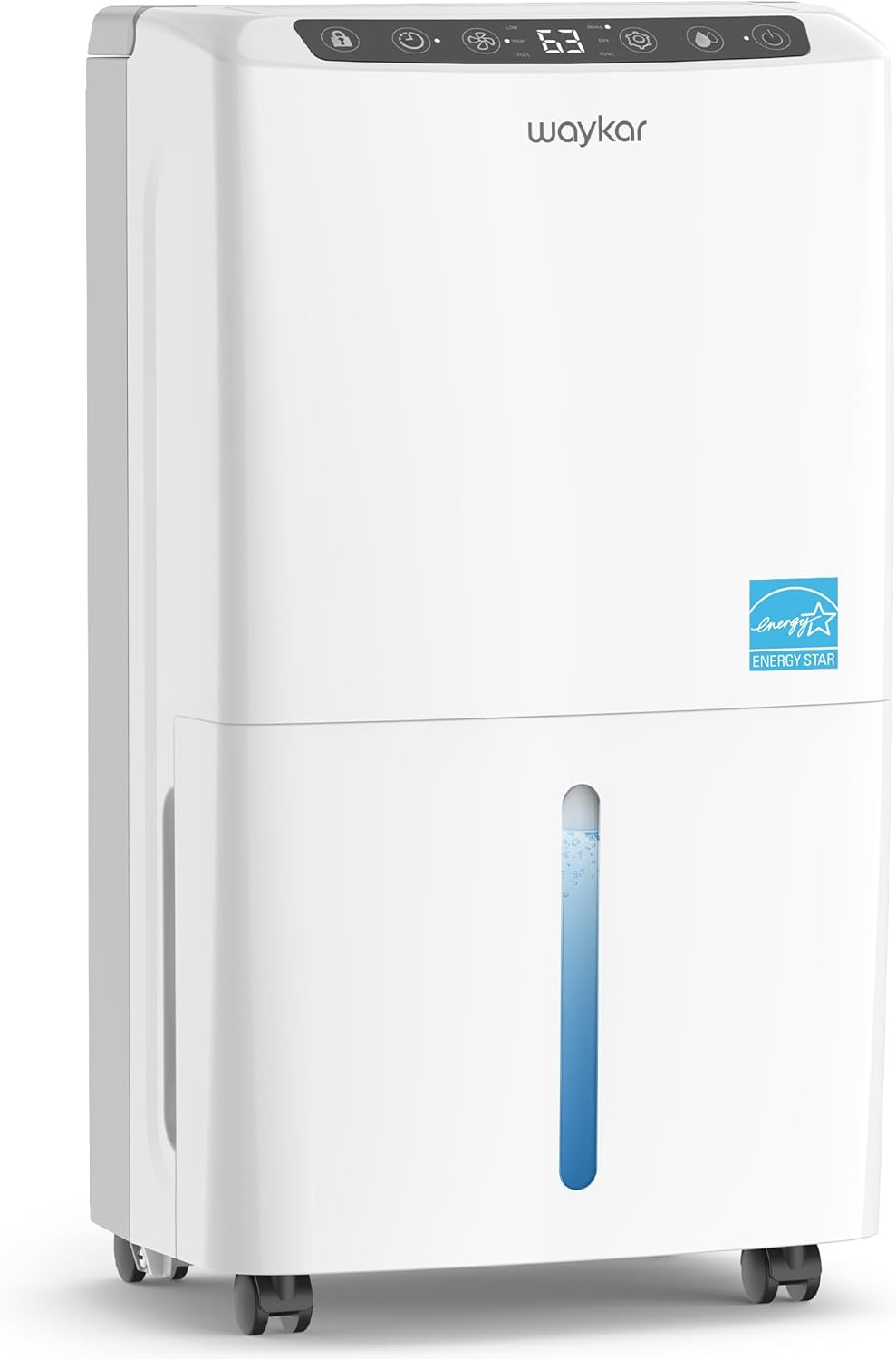
The Waykar 34 Pints carries the 2025 Most Efficient Energy Star listing, covers spaces up to 2,000 square feet, and gives you both drainage paths: automatic by hose, or manual with the 0.62 gallon tank. That flexibility is the reason it sits in the middle of this list.
For a bedroom, a home office, or a finished room where you do not want a hose running across the floor, the tank is a real answer. At 0.62 gallons, you are emptying it often in peak summer, so understand what you are signing up for. For a basement, switch to the hose and forget the tank exists. That is the whole point of buying a unit with both options: you can start with the tank and move to a hose the first week you get tired of carrying it.
The 2,000 square foot claim puts it below the VEAGASO on paper, and in a real house that gap is smaller than it looks, because both numbers assume conditions nobody has. What separates them is drainage, not coverage. The VEAGASO gives you a hose. The Waykar gives you a hose and a tank. Decide which one you need before you compare anything else.
How I test, and what the specs leave out
I run three routines on every unit that comes through my house. The bucket test: I weigh the water the machine pulls over a week of real humidity, not a lab chamber, and compare it against the box number. The meter week: a watt meter on the plug for seven days, then I do the monthly cost math at my utility rate, because energy use is a bill, not a spec. And the hygrometer check: my meter against the unit's humidistat, because a set point you cannot trust is a set point you will fight all summer.
Two things the spec sheet never tells you. The first is the temperature split. Compressor units win in warm, humid conditions, which is the Gulf Coast for eight months of the year. Desiccant units win in cold basements, where a compressor has less to work with. If your basement stays in the 50s, that matters more than the pint rating. The second is noise and placement. A unit that is too loud to run at night gets turned off at night, and a dehumidifier that runs twelve hours a day is doing half a job.
Then there is the tank-versus-hose question, which I will keep repeating until it sticks. Tank is fine for a bedroom. Hose is mandatory for a basement or a whole-floor unit. The tank-size war between brands will end the day hose-drain kits ship standard in every box, and I will not miss it.
The reference table
| Unit | Best for | Drainage | Coverage claim | Efficiency listing | Price |
|---|---|---|---|---|---|
 Visit on Amazon → Visit on Amazon →VEAGASO 34 Pint/D |
Basements with a floor drain or sump | Drain hose included | Up to 2,500 sq. ft. | None listed | $134.99 |
 Visit on Amazon → Visit on Amazon →AEOCKY with Pump (2024) |
Finished basements with no gravity drain | Internal pump, lift up to 16.5 ft. | Not stated | Most Efficient 2024 | $269.97 |
 Visit on Amazon → Visit on Amazon →AEOCKY with Pump (2025) |
The same job, with the tighter rating | Internal pump, lift up to 16.5 ft. | Not stated | Most Efficient 2025 | $242.96 |
 Visit on Amazon → Visit on Amazon →Waykar 34 Pints |
Rooms that need a tank option | Auto by hose or manual with 0.62 gal. tank | Up to 2,000 sq. ft. | Most Efficient 2025 | $165.98 |
Should you buy the VEAGASO 34 Pint?
Yes, if you have somewhere for the water to go. A floor drain, a sump pit, or a cleanout within hose reach turns this into a set-and-forget machine for the whole season, and the included drain hose saves you the accessory purchase. It is the least complicated answer on this list, and complicated is not what you want at 3 a.m. in July.
Skip it if your basement has no drain and no low exit. Without a gravity path, the hose is decoration, and you would be relying on a tank on a unit built around continuous drainage. That is the wrong tool for a finished space.
Should you buy the AEOCKY with Pump?
Yes, if the water has to go up. The 16.5 foot lift covers a utility sink, a laundry standpipe, or a window above the unit, and that is the situation in most finished basements I walk into. Between the two AEOCKY units, buy the 2025 version when the cost difference is small, because the efficiency bar moved and the newer listing reflects it. Buy the 2024 version when it is clearly cheaper and you would rather put the difference into a hose kit and filters.
Skip it if you already have a floor drain next to where the unit will sit. You would be paying for a pump you never use. Read more about that tradeoff in compressor versus desiccant and what your basement temperature does to both.
Should you buy the Waykar 34 Pints?
Yes, if you want both drainage options in one box. Tank for the bedroom, hose for the basement, and a 2025 Most Efficient rating either way. For a homeowner who is not sure yet where the unit will end up, that flexibility is worth more than a slightly larger coverage claim.
Skip it if you know the machine is going into a basement with a drain. Buy the hose-first unit and put the difference toward a second machine for the far end of the space. Two correctly placed units beat one oversized unit fighting a wet wall every time.
The bottom line
Match the drainage to the room before you compare anything else. Floor drain nearby, buy the VEAGASO. No drain and a finished ceiling, buy an AEOCKY with pump, and take the 2025 listing if the money is close. Want the option to move it from room to room, buy the Waykar. Every one of these is a portable compressor-style machine, so keep the space above 60 degrees, keep the filter clean, and keep your own hygrometer on the shelf to check the humidistat. If you want the full hose setup walkthrough, that is in my drain hose installation notes.