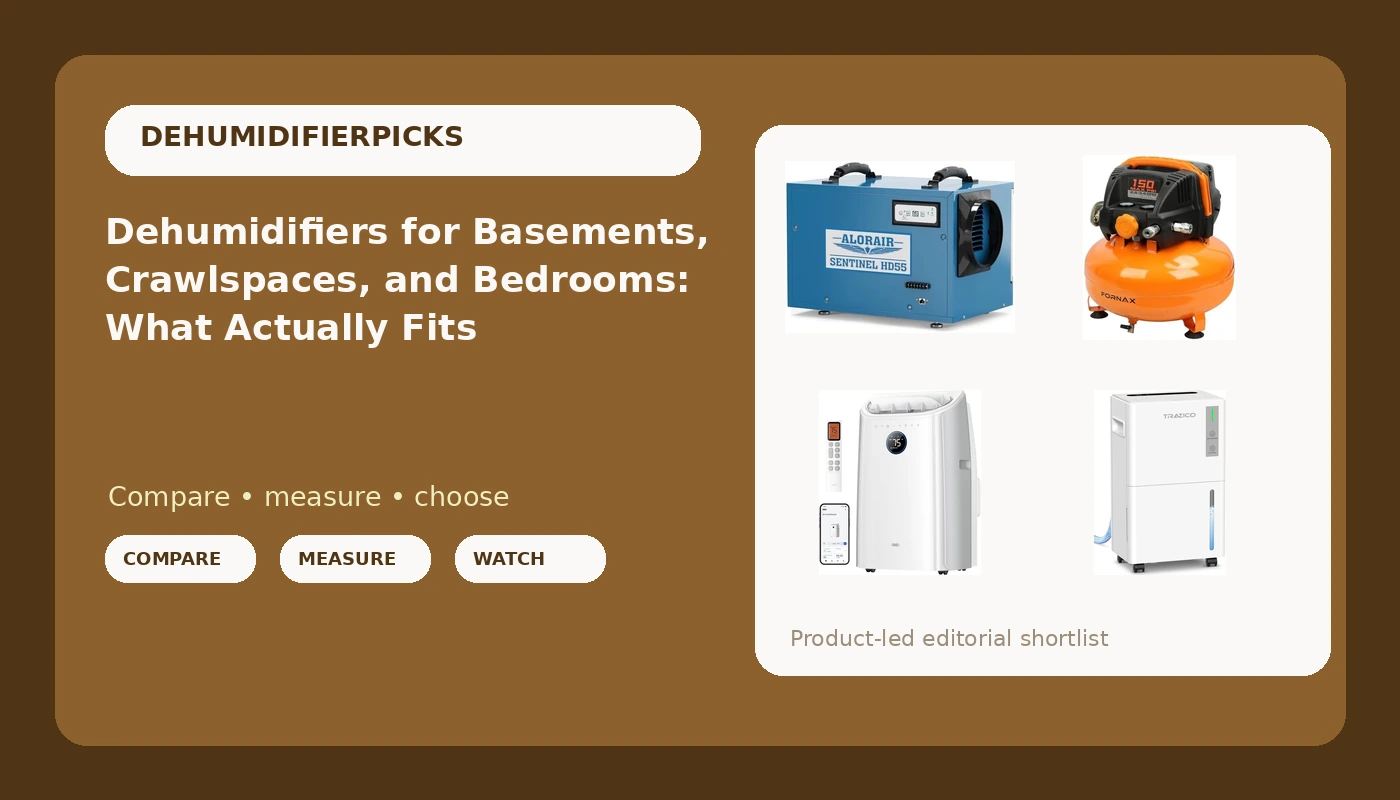
Somewhere in your house there is a room that smells like a wet towel, and the hygrometer you set on the shelf reads higher there than anywhere else. That room is why people go looking for basement and crawlspace dehumidifiers at eleven at night in July, and it is why the shopping page is confusing. The same aisle holds a 21 pint portable unit with a hose, a 113 pint crawlspace machine that looks like a small air handler, a portable air conditioner that happens to have a dehumidify mode, and an air compressor that does not remove water at all. Four different jobs are being sold with one word. This article separates them, explains what the pint number on the box actually means once the unit is sitting in a real room with a door gap and a leaky rim joist, and points to the machine that fits each job.
Related: How to Size a Dehumidifier for a Damp Basement →
Quick answer
For a basement up to roughly 1,500 square feet with a floor drain, sump pit, or any way to route a hose, a hose-drain compressor dehumidifier in the 20 to 25 pint class is the practical starting point, and the Trazico unit in that class includes a drain hose. For a crawlspace or a commercial room where nobody is going to empty a tank, the ALORAIR Sentinel HD55 is built for unattended drainage and is rated far higher. For a bedroom that gets stuffy and damp in summer, a portable air conditioner with a dehumidify mode such as the DREO 515S covers cooling and moisture in one footprint. The FORNAX pancake air compressor is not a moisture machine at all; it is the maintenance tool that keeps coils and condensate lines clear so the machines that do remove water keep working. The deciding factor is rarely the pint number. It is whether the unit can drain itself, and whether the space runs warm or cold.
Four useful options
| Model | Best fit | What stands out |
|---|---|---|
| Trazico 1500 Sq.Ft Dehumidifier for Basement, with Drain Hose, 21 Pints | Basements and finished lower levels with a drain point | 21 pint rating, 1,500 sq ft coverage claim, drain hose included |
| ALORAIR 113 Pints Crawlspace Dehumidifier for Commercial, Sentinel HD55 | Crawlspaces, commercial rooms, unattended installs | 113 pint rating, low-profile crawlspace form factor, commercial designation |
| DREO Portable Air Conditioner 515S | Bedrooms and small rooms needing cooling plus moisture control | 12,000 BTU ASHRAE and 8,000 BTU DOE ratings, fan and dehumidifier modes, app, voice, and remote control |
| FORNAX Pancake Air Compressor | Coil and condensate-line maintenance | 6 gallon tank, 150 PSI, oil-free, two couplers |
Basement duty: Trazico 1500 Sq.Ft Dehumidifier for Basement, with Drain Hose, 21 Pints
A 21 pint machine is the small end of the real compressor class, and that matters in both directions. In a basement of 600 to 900 square feet that sits at 55 to 60 percent relative humidity, it is sized to the job. In a 1,800 square foot open basement with a stone foundation and a humid summer, it will run continuously and lose ground. The 1,500 square foot figure in the product name is a coverage claim, not a guarantee; coverage depends on how much air the space exchanges with the outdoors, and an old basement exchanges a lot.
The drain hose is the part worth paying attention to. A tank on a basement unit means a daily chore in July and August, and if the tank fills overnight, the machine shuts off and the humidity climbs back while you sleep. If there is a floor drain, a sump pit, or a laundry sink within hose reach and gravity works in your favor, use it. If there is no drain point at all, plan on a condensate pump or plan on a different room.
Crawlspace and commercial duty: ALORAIR 113 Pints Crawlspace Dehumidifier for Commercial, Sentinel HD55
Here is the number that trips people up. A 113 pint crawlspace unit and a 21 pint portable unit are not rated under identical conditions. Crawlspace and commercial dehumidifiers are commonly rated at saturation conditions, where the air is close to fog, and the resulting number is large. A portable unit is rated at a standard warm-room condition. So the gap between 21 and 113 is real in capability, but it is not a simple five-to-one comparison. What the crawlspace class genuinely offers is a machine designed to sit on a vapor barrier, pull air through a coil, and drain through a hose for months without anyone touching it.
That is the actual dividing line: crawlspaces are hard to access, often unheated, and impossible to babysit. A tank is a non-starter. If your crawlspace stays cool, in the 50s and low 60s, pay attention to how the unit behaves in cold air, because compressor coils lose capacity as the air gets colder and frost can build on the coil. Cold-space performance is a specification question worth asking before you buy, not after the first winter.
Bedroom duty: DREO Portable Air Conditioner 515S
Two ratings on one box is not a marketing trick, it is a change in test standard, and the gap is large. The ASHRAE figure describes performance under one set of conditions, the DOE figure under a more demanding set. When you compare this unit to another portable air conditioner, compare ASHRAE to ASHRAE or DOE to DOE, never one to the other. For a bedroom in the 300 to 500 square foot range, the DOE number is the more useful one to think with.
The dehumidifier mode is the reason this unit is in a moisture article at all. In a bedroom that is humid but not hot, a portable air conditioner is a clumsy dehumidifier: it cools air as a side effect of drying it, and it dumps the heat it removed back into the room. What it does well is handle a room that is both warm and muggy, which is most upstairs bedrooms in a Gulf Coast summer. It also needs a window path for the exhaust hose and a place for condensate. The drainage-free cooling claim refers to how the unit manages its own condensate during cooling; running it purely as a dehumidifier in cool weather is a different operating mode and a different drain story, so read the manual on that point rather than assuming.
Maintenance duty: FORNAX Pancake Air Compressor
This is the honest odd one out. A pancake compressor removes no water from your air, and if you buy it expecting a drier basement you will be disappointed. What it does is support the machines that do the work. A dehumidifier coil matted with dust cannot transfer heat, and a matted coil pulls less water for the same electricity. Condensate lines clog with biofilm, and a clogged line on a hose-drain unit means water on the floor. A 6 gallon tank at 150 PSI with an oil-free pump and two couplers is enough for blowing out a drain line, clearing dust from a coil and a filter housing, and running a small nailer or inflator while you are already in the basement. Two couplers matter more than they sound: one line can stay on a blow gun while another feeds a tool, without swapping fittings every five minutes.
How to read a pint rating in a real house
Pints per day is a laboratory number. It is measured at a fixed temperature and a fixed humidity, with the machine running under conditions your basement will not match. Real rooms have door gaps, rim joist leaks, dryer vents, and a stairway open to the upstairs. Air exchange brings new moisture in as fast as the coil takes it out. A common working rule in the trade is to expect roughly 30 to 40 percent less real-world moisture removal than the box number suggests, and that rule gets worse in a leaky old foundation and better in a tight, sealed, finished basement.
The second number that matters is temperature. Compressor dehumidifiers are at their best in warm air and lose capacity as the space cools, which is why a cold crawlspace or an unheated garage is a harder assignment than a 75 degree basement. Desiccant dehumidifiers handle cold air better and generally cost more to run because they heat the air as part of the drying process. Neither type is universally better. They are matched to different rooms.
Third, match the unit to a target, not to a feeling. A hygrometer costs less than a tank of gas and tells you whether you are at 48 percent or 68 percent. Most basements are comfortable and mold-resistant in the 45 to 55 percent range. Chasing 30 percent is wasted electricity.
Compressor or desiccant, and the hose question
Run the two questions in order. First, is the space warm or cold? Warm basement, conditioned crawlspace, or a room above 65 degrees points to a compressor unit. Cold crawlspace, unheated garage, or a workshop that sits in the 40s and 50s points toward desiccant, or toward a low-temperature rated compressor built for that job.
Second, can it drain itself? A tank is acceptable in a bedroom or a small room where you pass the unit every day. A tank is a liability in a basement and a deal breaker in a crawlspace. If you have a floor drain, a sump, or a sink within reach and gravity on your side, a hose is a ten-minute installation. If gravity is against you, a condensate pump is the standard answer, and it is worth budgeting for it at the same time as the unit.
- Measure the room and write the square footage down, including any open stairwell or adjoining space.
- Buy or borrow a hygrometer and log the reading morning and evening for a week.
- Find your drain point before you shop, and decide whether gravity or a pump will move the water.
- Check the temperature of the space in the coldest month it will run, not in July.
- Size to the leaky reality of the room, not to the box, and accept that a big open basement may need two units or a sealed crawlspace instead of one machine.
Practical guidance for a damp room
- Seal the obvious air paths first. A dehumidifier fighting an open rim joist is a dehumidifier running for nothing.
- Give the unit 12 to 18 inches of clearance on all sides. A unit pushed against a wall recycles its own warm exhaust.
- Clean or rinse the filter monthly during the humid season. A clogged filter is the most common cause of a machine that suddenly stops pulling water.
- Route the hose with a continuous downward slope and no low spots where water can sit and grow biofilm.
- Put a cheap water alarm under any hose-drain installation, especially in a finished basement.
- If the machine runs constantly and the hygrometer does not move, the problem is usually the building, not the box.
Which option should you choose?
Choose the Trazico 1500 Sq.Ft Dehumidifier for Basement, with Drain Hose, 21 Pints when you have a basement or lower level in the several-hundred to roughly 1,500 square foot range, a drain point for the included hose, and a space that stays warm enough for a compressor to work efficiently. Choose the ALORAIR 113 Pints Crawlspace Dehumidifier for Commercial, Sentinel HD55 when the space is a crawlspace or a commercial room that must run unattended for months and cannot be emptied by hand. Choose the DREO Portable Air Conditioner 515S when the problem room is a bedroom that is hot and humid at the same time and you would rather buy one appliance than two. Choose the FORNAX Pancake Air Compressor when what you actually need is to maintain the equipment you already own: clear condensate lines, clean coils, and keep filters and housings free of dust.
One caveat applies to all four. Capacities, coverage claims, and BTU figures come from manufacturer ratings under standardized test conditions, and standardized conditions are not your house. None of the numbers above should be treated as a measured result in your specific space, and no current price, rating, or stock status is stated here without current evidence.
The bottom line
The moisture problem in a house is almost always a drainage and air-sealing problem wearing a dehumidifier as a costume. Buy the machine that can run without you: a hose-drain compressor unit in the 20 to 25 pint class for a warm basement, a low-profile commercial unit for a crawlspace you never visit, a portable air conditioner with a dehumidify mode for a bedroom that is both warm and muggy, and a small oil-free compressor to keep coils and drain lines clear so the first three keep working. Then verify the result with a hygrometer instead of a feeling, because the only number that matters is the one in your own room.