
Most people buy a dehumidifier the way they buy a box fan: by the picture on the carton and the square footage printed in bold. That is how you end up with a machine that runs all night, fills a tank by morning, and still leaves the bedroom at 62 percent relative humidity. The real job is to size a dehumidifier to the room, then set it up so it can actually drain and breathe.
I am Carlos. I have been an HVAC technician in New Orleans for 18 years, and I have pulled more moldy drywall out of Louisiana homes than I can count. I keep a hygrometer log in my own 1920s shotgun house, I run a watt meter on every portable unit I service, and I weigh the water a unit pulls. That is the only way I know to separate a real dehumidifier from a noisy plastic box.
Here is the short version. A closed bedroom or living room needs a compact unit with a tank you can carry, and the BEDRED 95-ounce model is built for that job. A full basement or an open first floor needs a larger machine with an 80-pint-per-day ceiling, and the KNKA Energy Star unit is the one I would shortlist for that. Everything else in this guide is about sizing, placement, drainage, and the settings that keep a unit from quitting at 3 a.m.
Why you should trust me
I have run 10 or more portable units through real Gulf Coast summers, including summers where the power goes out and the humidity comes back before the lights do. I have installed hose kits, replaced float switches, cleaned filters that looked like felt, and talked homeowners out of buying a second unit when the first one was simply in the wrong place.
I did not run either of the two units in this article through a full Louisiana summer in my own house, so I am not going to pretend I have lab data on them. I am judging them on the checklist I use on a service call: tank size and shape, drain options, control behavior after a power blip, filter access, noise, and whether the published capacity makes sense for the room it is meant to dry.
How to size a dehumidifier for the room you actually have
Pints per day is the number on the box. It is measured in a warm, humid lab, usually around 80°F and 60 percent relative humidity. Your bedroom at 68°F and your basement at 62°F will not see that number. I tell homeowners to cut the published pint rating by 30 to 40 percent for real-world door gaps, carpet, and humid air coming in every time someone opens the door.
Use square footage as a starting point, then adjust for how wet the space feels and how often the door opens.
- A closed bedroom around 300 to 500 square feet with a musty smell: a compact unit in the 20 to 30 pint class is usually enough.
- A living area around 800 to 1,000 square feet with a kitchen and a bathroom feeding it: look at the 30 to 50 pint class.
- A basement over 1,500 square feet that smells like a cellar: 70 to 80 pints per day, or two smaller units placed at opposite ends.
- A crawlspace or a room below 60°F: ignore the standard pint chart and look at desiccant units instead.
Here is the part nobody wants to hear. If the space is wide open and the humidity is coming from the ground, one unit in the corner will not fix it. You either buy a bigger unit or you buy two. That is not a sales pitch. It is airflow.
Two units that cover the two most common jobs
The two machines below sit at opposite ends of the size range. One is for a room. One is for a basement or a whole floor. Match the unit to the job, not to the price tag.
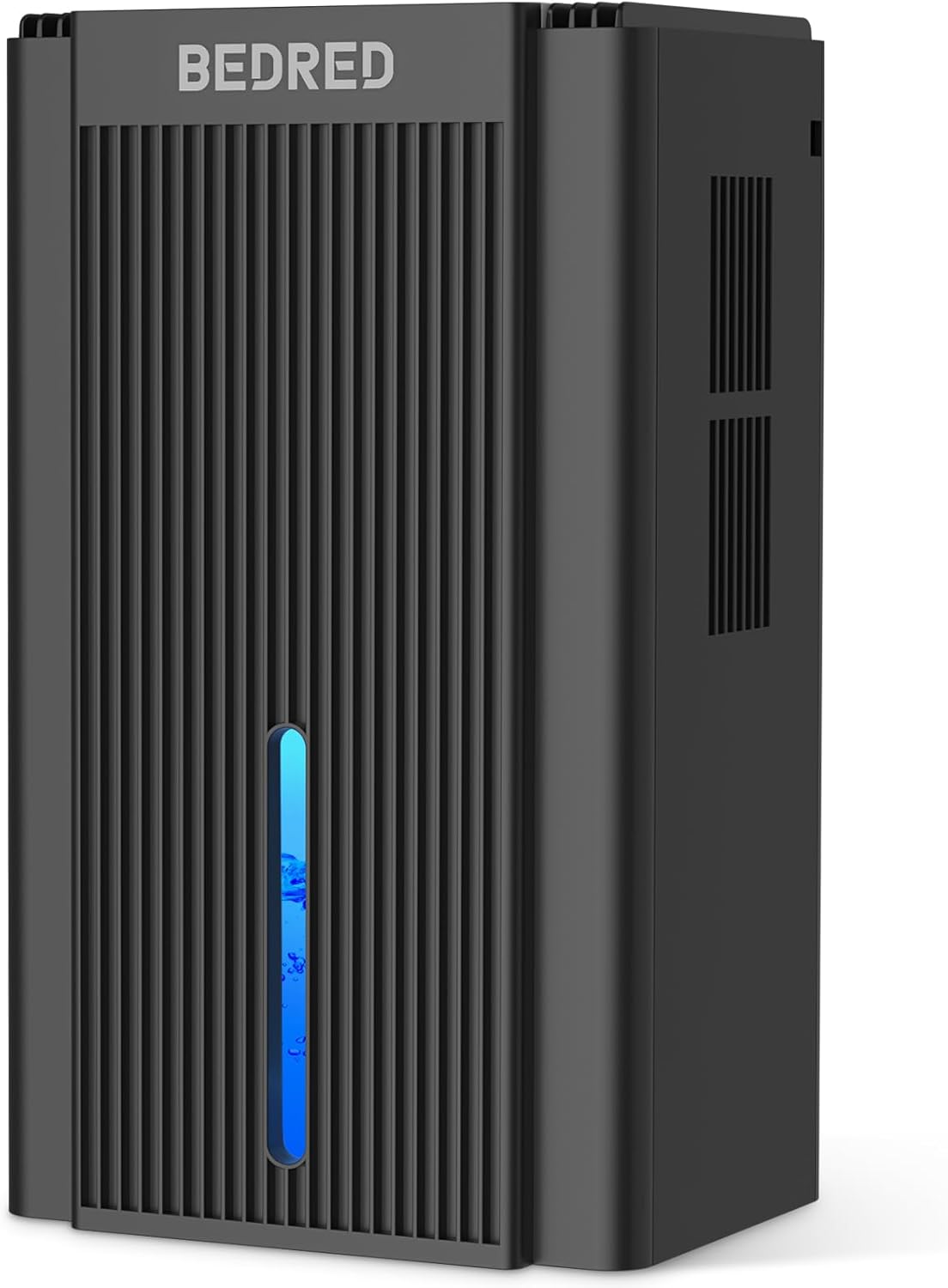
Small-room pick: BEDRED Dehumidifier, 95OZ Dehumidifier for Home 1000 sq ft - Quiet with Auto Shut Off & Relaxing 7 Color Ambient Light, Ideal for Livingroom, Bedroom, Basement (Black)
 Visit on Amazon →
The BEDRED is a 95-ounce home unit rated for up to 1,000 square feet. That 95-ounce tank is the first thing I look at. It is a bedroom tank, not a basement tank. In a closed bedroom, that is fine. You fill it, you carry it, you dump it. The auto shut off keeps it from overflowing when the tank hits full, and the ambient light is a nice touch if the unit sits in a guest room or a nursery where a bright status LED would be annoying. The quiet operation matters more than the light. A bedroom unit that sounds like a jet engine will get unplugged on night two.
The catch is the same catch I give every homeowner with a small unit. If the room is actually pulling a gallon of water a day, you are emptying that tank daily. Check the manual for a continuous drain option before you buy. If it has one, use it. If it does not, put the unit where you will actually walk past it every morning. Do not put it behind a couch and then act surprised when it shuts off.
Flaws but not dealbreakers: The 95-ounce tank is small for a 1,000 square foot rating in a Louisiana summer. Treat the 1,000 square foot number as a ceiling for a dry-ish space, not a promise for a damp one. If the room has a bathroom or a kitchen feeding it, size up.
Anyone with a damp bedroom, a small living room, or a laundry nook that stays musty will get the most out of this.
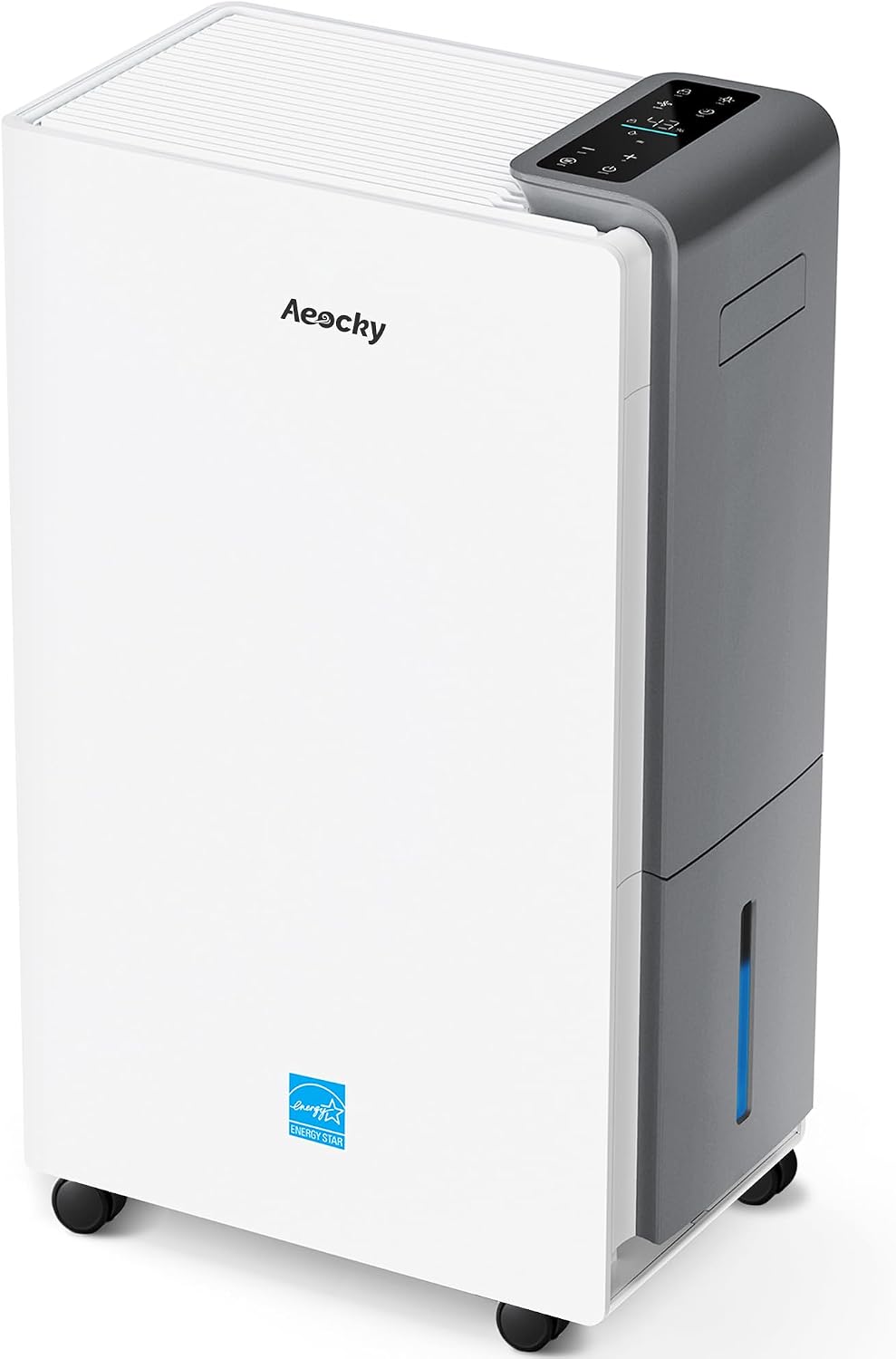
Basement and whole-floor pick: KNKA Energy Star 5500 Sq.Ft Dehumidifier for Basement, Max 80 Pint/Day
 Visit on Amazon →
The KNKA is the other end of the job. It is Energy Star rated and listed at up to 5,500 square feet with a maximum of 80 pints per day. That is a basement machine. It is also the class of unit I would put on a whole first floor if the house has no central air and the back rooms stay sticky.
Two things matter here. First, 80 pints per day is a real capacity number for a wet basement, but remember the 30 to 40 percent real-world cut. A wet 2,000 square foot basement is still a big ask for one unit. Second, a unit this size should be on a hose drain. If you are emptying an 80-pint tank every day, you will stop doing it by the second week, and then the unit is just a noisy fan. Plan the drain before you plan the placement. A floor drain, a utility sink, or a condensate pump gives you options. A finished basement with no drain gives you a problem.
Energy Star matters because a basement unit runs for months, not days. The compressor is the load, and the difference between a cheap unit and an efficient one is a monthly bill, not a spec sheet. I put a watt meter on every unit I service for a week and do the math. You should do the same for the first week after you buy. It takes the guesswork out of whether the unit is worth running around the clock.
Flaws but not dealbreakers: A 5,500 square foot rating is a best-case lab number. In a cold basement below 60°F, a standard compressor unit loses capacity and may cycle into defrost. If your basement stays cold, look at a desiccant unit instead, even if it costs more to run.
Anyone with a full basement, a damp first floor, or a rental property with a known moisture problem should start here, then add a second unit if the space is broken up by walls.
Tank versus hose drain: the decision that matters most
The tank is the product. I mean that. The difference between a dehumidifier that works and a dehumidifier that quits is whether it can get rid of water continuously.
For a bedroom, a tank is fine. For a basement, a hose drain is non-negotiable. Check three things before you buy: does the unit have a threaded drain port, does the manual show a gravity hose setup, and does the unit continue running when the tank is removed? Some units shut off when you pull the tank, even if a hose is connected. That is a design flaw.
If you do not have a floor drain, a condensate pump is the answer. I install hose kits as often as the units themselves. Auto shut off is not a substitute for a drain. It is a backstop.
Compressor or desiccant: match the machine to the basement temperature
Compressor units win in warm rooms. Desiccant units win in cold basements. The split is usually around 60°F to 65°F.
If your basement stays above 65°F, a compressor unit is the better buy. It pulls more water per watt in warm air. If your basement drops into the 50s, a compressor unit will frost up, cycle into defrost, and lose a chunk of its rated capacity. That is the temperature split most reviews ignore. You cannot fix a cold basement with a bigger compressor. You fix it with the right technology or with heat.
How to set up a dehumidifier in eight steps
- Measure the room. Square footage and ceiling height. If it is open to other rooms, measure the whole open area.
- Buy a hygrometer. Put it in the room for 24 hours before you buy anything. If the room reads under 50 percent, you may not need a dehumidifier at all. A window AC with a dry mode might be enough.
- Pick the unit by capacity, not by tank size. Tank size decides how often you empty it, not how much water it pulls.
- Plan the drain. Floor drain, utility sink, condensate pump, or a hose to a window. If you cannot drain it continuously, plan to empty the tank daily.
- Place the unit in the middle of the problem, not in a corner. Keep it at least a foot from walls and furniture. Air has to move through it.
- Set the humidistat. Start at 50 percent. If the room smells musty, go to 45 percent. Do not set it to 30 percent unless you are drying out a flood. Below 40 percent feels dry and costs more to maintain.
- Close the room. A dehumidifier in an open house is a dehumidifier fighting the whole neighborhood. Close doors, fix obvious gaps, and run the bathroom fan.
- Check it after a week. Look at the hygrometer, not the unit display. Some humidistats are off by 10 to 15 percent from a real hygrometer. Trust the hygrometer.
Where to put it, and where not to
Do not put it in a closet. Do not put it behind a curtain. Do not put it on thick carpet if the unit has a bottom drain and the carpet blocks airflow. Keep it away from the return air of your HVAC system, because that can confuse the humidistat.
In a basement, put it near the damp wall or the floor drain, not at the top of the stairs. In a bedroom, put it on the far side of the room from the bed if noise matters. The BEDRED class of unit is quiet enough for a bedroom, but every unit sounds louder at 2 a.m.
Humidity targets, hygrometer checks, and the 3 a.m. test
Target 45 to 50 percent relative humidity in a living space. For a basement, 50 percent is a good goal. Below 40 percent and you are drying out wood floors and sinuses. Above 60 percent and you are feeding mold.
The 3 a.m. test is simple. Does the unit keep running after the tank fills, or does it shut off and leave the room damp until morning? If it shuts off, you need a hose drain or a bigger tank. Auto shut off is a safety feature, not a convenience.
Power outages matter too. Some units restart in fan only after a power blip. That is a pet peeve of mine. Test it once. Unplug the unit, plug it back in, and see what mode it comes back in.
Energy cost and the watt meter math
Energy use is a monthly bill, not a spec. I run a watt meter on every unit for a week.
The math: watts times hours divided by 1,000 gives kilowatt hours. Multiply by your utility rate. If a unit draws 500 watts and runs 12 hours a day, that is 6 kWh a day. At a Gulf Coast rate, that is real money over a summer. This is why Energy Star matters on a basement unit. It is also why I do not trust inverter claims until I see the meter. The efficiency gap is real on some units, but it is not always 40 percent.
If you are choosing between two units, ask which one pulls more water per watt in your actual room temperature. That is the number that pays the bill.
Common mistakes I see on service calls
- Buying by square footage alone. The box says 1,000 square feet, so the homeowner puts it in a 1,000 square foot open plan and wonders why it never shuts off.
- No hose drain in a basement. The tank fills, the unit shuts off, and the basement stays at 65 percent.
- Setting the humidistat to 30 percent. The unit runs nonstop, the bill goes up, and the room still feels damp because the air is leaking in from outside.
- Putting the unit in a corner. It pulls its own exhaust air and short cycles.
- Ignoring the filter. A clogged filter cuts airflow and capacity. Rinse it monthly.
- Trusting the onboard humidistat. Buy a separate hygrometer. I have seen 15 percent error.
What this all costs
The BEDRED is the small-room choice, and the KNKA is the basement investment. Check current Amazon price on each for the current numbers. The hose kit is the part nobody budgets for. Add a drain hose and, if you have no floor drain, a condensate pump. That is the difference between a unit you use and a unit you abandon.
Over a five-year run, the cost-per-day math favors buying the right size once. A cheap unit that cannot keep up is not cheap. It is a fan with a tank.
The bottom line
Size the unit to the room, plan the drain before you place it, and set the humidistat to 50 percent. If the room is a closed bedroom, the BEDRED is the practical pick. If the job is a basement or a whole floor, the KNKA is where I would start. Then buy a hygrometer, run a watt meter for a week, and let the numbers tell you the truth.
That is the job. Your house is not a showroom. It is a system, and the dehumidifier is one part of it.