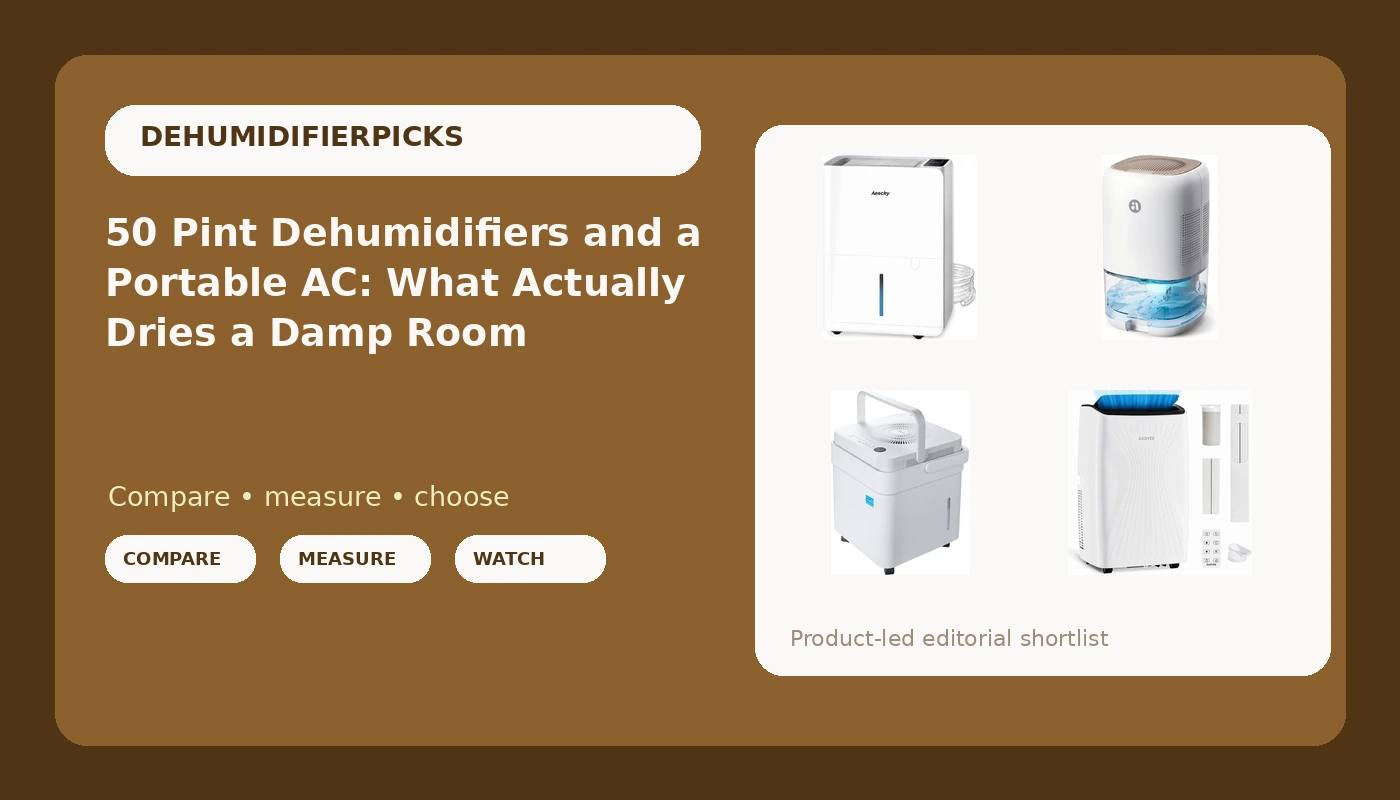
I have pulled moldy drywall out of more Louisiana homes than I can count, and the machine sitting in the corner is almost always part of the story. Either it quit at 3 a.m. with a full tank, or it was undersized for the square footage, or it was a cheap box that never pulled a real pint in Gulf Coast air. This portable dehumidifier comparison covers the four units readers keep asking me about this fall: two 50 pint machines, a 35 ounce bedroom unit, and a 14,000 BTU portable air conditioner that also runs a dehumidify mode.
The short version: for a basement, a crawlspace, or a whole floor, buy a 50 pint compressor unit and put a hose on it. For one muggy bedroom with no drain, a small tank unit can work, but you will empty it daily in July and August. And if your actual problem is heat plus humidity, a portable AC with a dry mode often does more for the room than a dedicated dehumidifier at the same money.
The best pick for most damp houses here is the Midea Cube 50 Pint with Pump, because the built-in pump lets you move condensate uphill to a sink or window, which is the difference between a machine that runs all summer and one you babysit. The AEOCKY is the better value if gravity can do the work for you. The other two are specialty answers, and I will explain which rooms they fit.
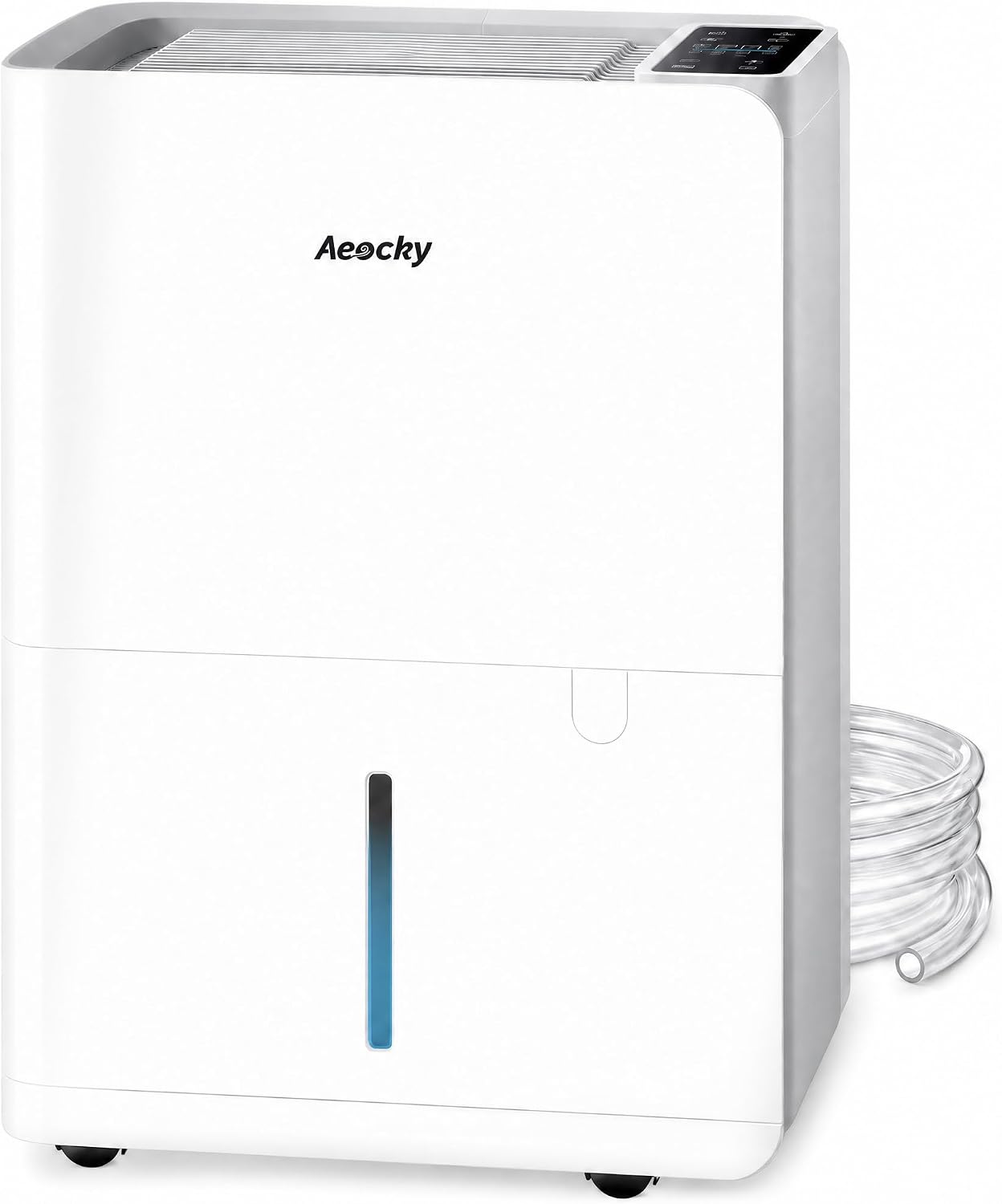
AEOCKY 50 Pint/Day, 3500Sq.Ft Ultra-Quiet 40dB Dehumidifier with Drain Hose
Real 50 pint capacity, drain hose included, straightforward controls with nothing to fail
No pump, so drainage is gravity only; you need a floor drain or a downhill path
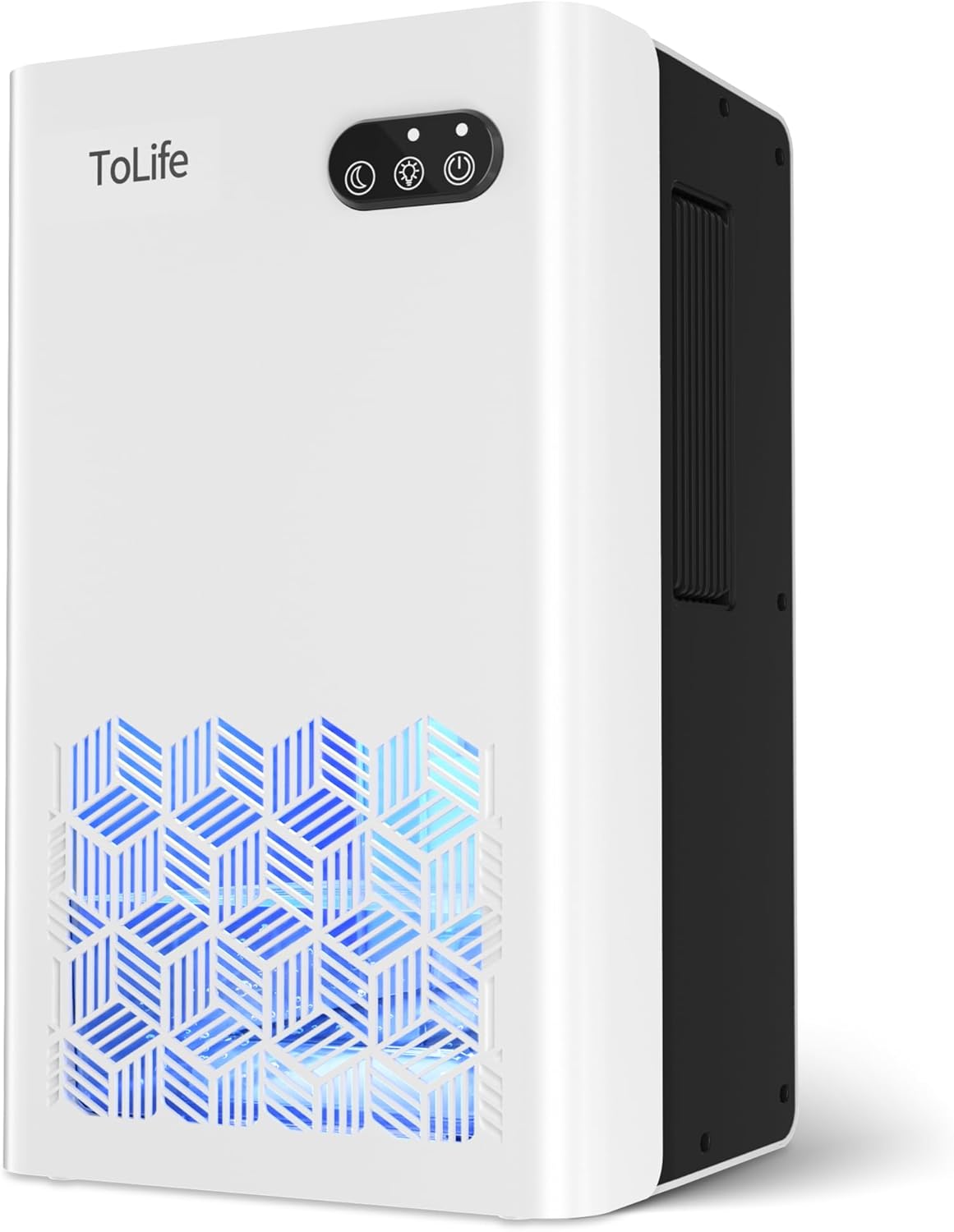
TABYIK 35 OZ Dehumidifier for Bedroom RV, Quiet with Auto Shut Off, Gold
Small, quiet, auto shut off, a low-cost entry for a bedroom or an RV
A 35 ounce tank is about a quart, and there is no hose port to automate it
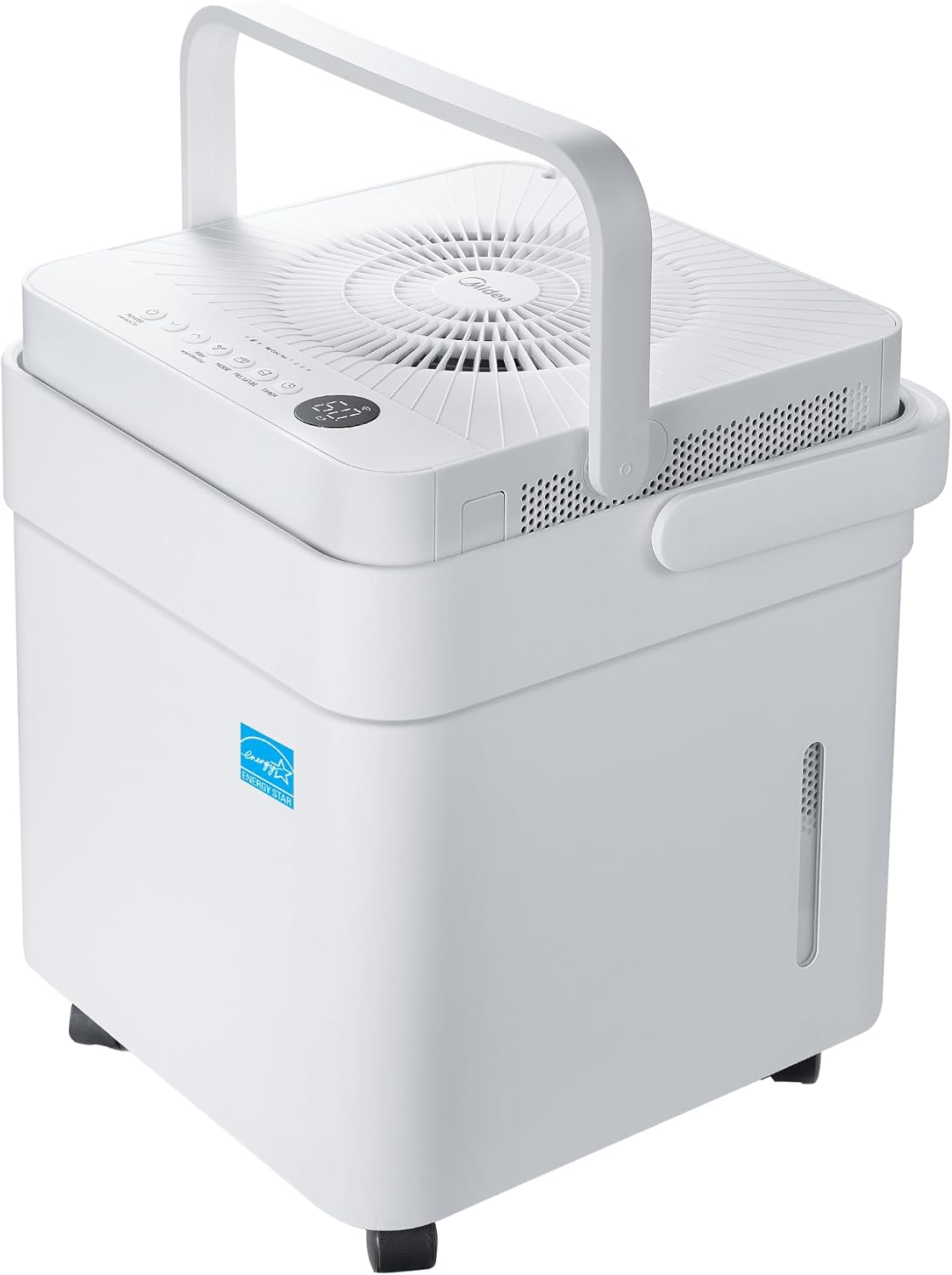
Midea Cube 50 Pint Dehumidifier with Pump, 4,500 Sq. Ft, Smart Control
Built-in pump, 50 pints, large coverage rating, cube body stacks for storage
The app module is the first thing to fail; pump adds cost you may not need
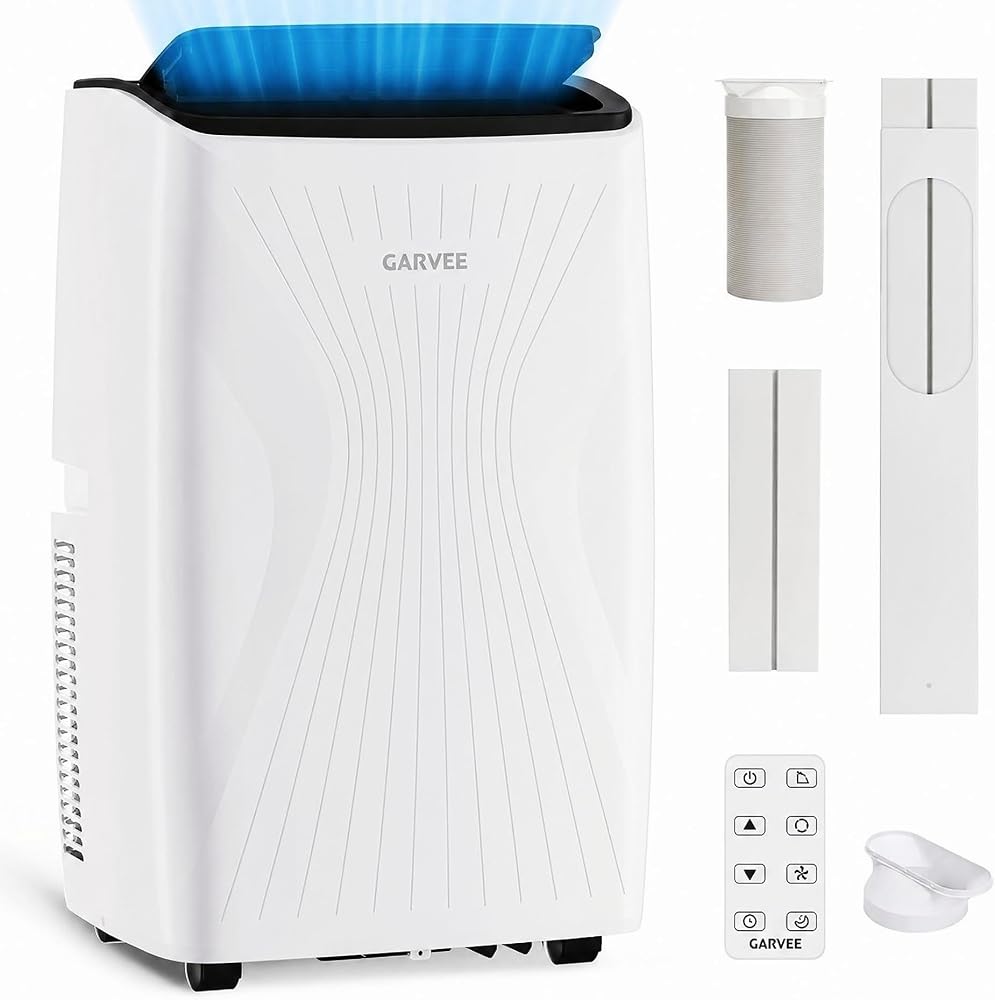
14,000 BTU Portable Air Conditioner, 4-IN-1 Portable AC Unit with Cooling, Dehumidifier, Fan, Sleep
Cools and dries at once, remote, timer, install kit in the box
It is an air conditioner first; bigger footprint and it needs a sealed window kit
Prices and availability were captured from Amazon Creators API and may change.
The three numbers that decide this
Pints per day, tank size, and whether there is a hose port. Everything else, the app, the LED display, the remote, is decoration until those three are right.
Pints per day is a lab number. It is measured at a temperature and humidity combination that does not exist in a Louisiana August. In real humidity, with real door gaps and a house that leaks air, cut the rating by 30 to 40 percent. A 50 pint machine in a bad room behaves like a 30 to 35 pint machine. That is not a knock on any brand, it is how the standard is written, and it is why I tell people to size up rather than down.
Tank size is the number nobody prints on the front of the box. A 35 ounce tank is a little over a quart. In a genuinely humid bedroom that is a tank you empty twice a day, and the auto shut off that protects the pump is also the thing that stops dehumidification at 3 a.m. The tank is the product. A unit that quits when the tank fills is a unit that quits in the worst month of the year.
Hose drain is non-negotiable for a basement, a crawlspace, or a whole-floor setup. I install hose kits as often as I install units. If you have no floor drain and no downhill path to a sink, a built-in pump changes what is possible, because it can push water uphill and across a room.
Temperature matters too. Compressor units win in warm, humid air, which is most of the Gulf Coast. Desiccant units win in cold basements, and most reviews ignore that split entirely. Every unit here is a compressor machine or an air conditioner, so this is a warm-weather comparison.
Last thing: energy is a monthly bill, not a spec sheet line. I run a watt meter on units for a week and do the math against my utility rate. A machine that pulls more watts but runs half as long is the cheaper machine, and you cannot see that on a label.
AEOCKY 50 Pint/Day, 3500Sq.Ft Ultra-Quiet 40dB Dehumidifier with Drain Hose
This is the straightforward 50 pint compressor box, and the listing tells you what you are buying: a 50 pint per day rating, a claimed 3,500 square foot coverage, a 40 dB noise claim, and a drain hose in the box.
The drain hose is the part I care about. A 50 pint machine with no hose port is a machine you empty every day, and at that capacity the tank fills fast. Having the hose included means you can set it in a basement, run the line to a floor drain, and forget it exists until the filter needs a rinse.
The 40 dB claim is where I raise an eyebrow, the same eyebrow I raise at every quiet claim. Decibel ratings on dehumidifiers are usually taken at a distance and at a fan speed you will not run. Compressor noise is also cyclical: the fan is steady, the compressor kicks in and out. Expect a unit like this to be audible in a bedroom and easy to forget in a hallway or a basement.
Where it loses ground is drainage flexibility. No pump means gravity only. If your only drain option is a sink above the unit or a window sill, this is not the machine for you. If you have a floor drain or a downhill path, you are paying for capacity instead of paying for a pump, and that is a fair trade.
Good fit for: an open basement, the first floor of a raised cottage, a garage workshop.
Midea Cube 50 Pint Dehumidifier with Pump, 4,500 Sq. Ft, Smart Control
Midea is one of the brands with a real compressor supply chain, and it shows in the details. You get the same 50 pint rating as the AEOCKY, a larger 4,500 square foot coverage claim, a built-in pump, and app control. The cube shape is a genuine storage win, because the bucket stacks inside the body when the unit is off, which matters in a house where the dehumidifier lives in a closet eight months a year.
The pump is the feature that justifies the price gap. With a pump you are not limited to gravity. You can push condensate up to a sink, out a window, or across a basement to a drain, and the unit keeps running unattended. For a whole-floor setup or a crawlspace, that is the difference between a machine that works and a machine you resent.
The smart control is where I get skeptical, and it is not specific to Midea. I have reset more Wi-Fi modules than compressors. The app is convenient until it becomes a support call, and a dehumidifier is a set-and-forget appliance. If the app works, great. If it does not, the unit still has to run on its own humidistat, and that is the part I check first.
The 4,500 square foot number deserves the same discount as everything else. In real humidity, treat it as a large open area, not a whole house with closed bedroom doors. A dehumidifier cannot dry a room it cannot get air into. If you want the whole house dry, you need airflow between rooms or more than one unit, and nobody wants to hear that.
TABYIK 35 OZ Dehumidifier for Bedroom RV, Quiet with Auto Shut Off, Gold
This one is a different animal: a 35 ounce tank, quiet operation, auto shut off, and a gold finish aimed at a nightstand rather than a basement.
I want to be fair to it, because small units have a real job. A 35 ounce tank is about a quart, which makes this a spot dehumidifier for a closet, a bathroom, an RV, or a bedroom that gets muggy but not wet. In a small, closed space it takes the edge off, and the auto shut off protects it from overflowing, which is the minimum I expect.
Understand the arithmetic before you buy. If a room is producing two quarts of condensate a day, you are emptying this tank twice a day, and the auto shut off means it stops dehumidifying the moment the tank fills. That is the tank-is-the-product problem in its purest form. There is no hose port mentioned on this unit, so there is no way to automate it.
For a bedroom where the complaint is "it feels clammy" rather than "the walls are wet," a small unit can be enough, and it costs a fraction of a 50 pint machine. For a basement, it is a rounding error. Do not buy a quart tank and expect it to dry a 1,000 square foot floor. I have watched that purchase happen in too many houses, and the unit ends up in a closet within a month.
14,000 BTU Portable Air Conditioner, 4-IN-1 with Dehumidifier Mode
This is the one people forget to consider, and in some rooms it is the right answer. It is a 14,000 BTU portable AC rated for rooms up to 750 square feet, with cooling, dehumidify, and fan modes, sleep mode, auto swing, a 24 hour timer, a remote, and an installation kit in the box.
Here is the honest framing: this is an air conditioner first. The dehumidify mode is real, and any portable AC pulls moisture out of the air as part of cooling, but it is not a dedicated dehumidifier and it does not have the large tank or the continuous hose drainage the 50 pint machines do. What it has is cooling, and if your damp room is also an 85 degree room, cooling is what you actually want. A dehumidifier adds heat to the space, because the compressor and fan reject heat into the room. An AC removes it. In a New Orleans September, that difference decides whether you can stand to be in the room.
The trade-offs are footprint and installation. A portable AC is a bigger box, it needs a window or a slider for the exhaust kit, and the window kit is the weak point in most setups. Seal it properly or you are paying to cool the neighborhood. The 14,000 BTU rating is a lab number like everything else, and a hot, leaky room with a poorly sealed window kit will not see the full benefit.
Where I would buy this over a dehumidifier: a bedroom, a home office, or a converted garage that is hot and humid at the same time. Where I would not: a basement or crawlspace, where there is nothing to cool and you need a machine that runs unattended for weeks.
What the table does not tell you
Coverage claims do not survive closed doors. Every square footage number here assumes open air and a certain ceiling height. Close the bedroom doors and the 4,500 square foot claim becomes a hallway claim. If your damp problem is in three closed rooms, one big unit in the hall is not a solution. Two smaller units, or air movement you can actually feel, is the fix, and that is the answer homeowners least want to hear.
Noise claims are distance dependent, and compressor cycling is not measured at all. The 40 dB figure on the AEOCKY and the quiet claim on the TABYIK are both about fan noise at some distance. What wakes you up is the compressor kicking on. Think about where the unit sits relative to your head before you trust any decibel figure.
Tank versus hose is the real decision. If you are willing to empty a tank every day, buy the smallest unit that handles the room and accept the chore. If you are not, buy a hose port or a pump, because a dehumidifier that shuts off at 3 a.m. is not doing its job in the month you need it most.
And the humidistat on every one of these is a sensor, not an instrument. I have seen them off by 15 percent against my hygrometer. Set it a few points lower than your target and verify with a cheap hygrometer on the other side of the room. Do not treat the display as gospel.
What I would buy for which room
Damp basement or crawlspace with a floor drain: the AEOCKY 50 Pint/Day. You get 50 pints of capacity and a hose in the box, and gravity does the rest. No pump needed, no app needed.
Damp basement or crawlspace with no drain and no downhill path: the Midea Cube 50 Pint with Pump. You are paying for the pump, and the pump is the reason the machine runs all summer without you. The smart control is a bonus you should be prepared to ignore if it misbehaves.
One muggy bedroom or an RV: the TABYIK 35 OZ. Small, quiet, auto shut off, and honest about what it is. Just go in knowing a quart tank is a daily chore in a humid climate.
Hot and humid room, especially a bedroom, office, or converted garage: the 14,000 BTU portable air conditioner. If the room is uncomfortable because of temperature and humidity together, cooling beats drying. Buy it for the cooling and treat the dehumidify mode as a bonus.
If you are stuck between the two 50 pint units, the question is simple. Can the water reach a drain by gravity? If yes, save the money and buy the AEOCKY. If no, buy the pump.
What I am watching next
Inverter compressors are the thing to watch. The efficiency claims are large and the meter math is real, and I expect inverter machines to become the default in this category within a few years as energy costs keep climbing. I score that prediction every January.
The other shift I expect is hose kits becoming standard in the box. The tank-size war is a marketing war, and the moment buyers start treating a drain hose as a requirement instead of an accessory, the spec sheets will change. Until then, read the box contents before you buy, because the tank you do not have to empty is the feature that actually keeps a dehumidifier running.